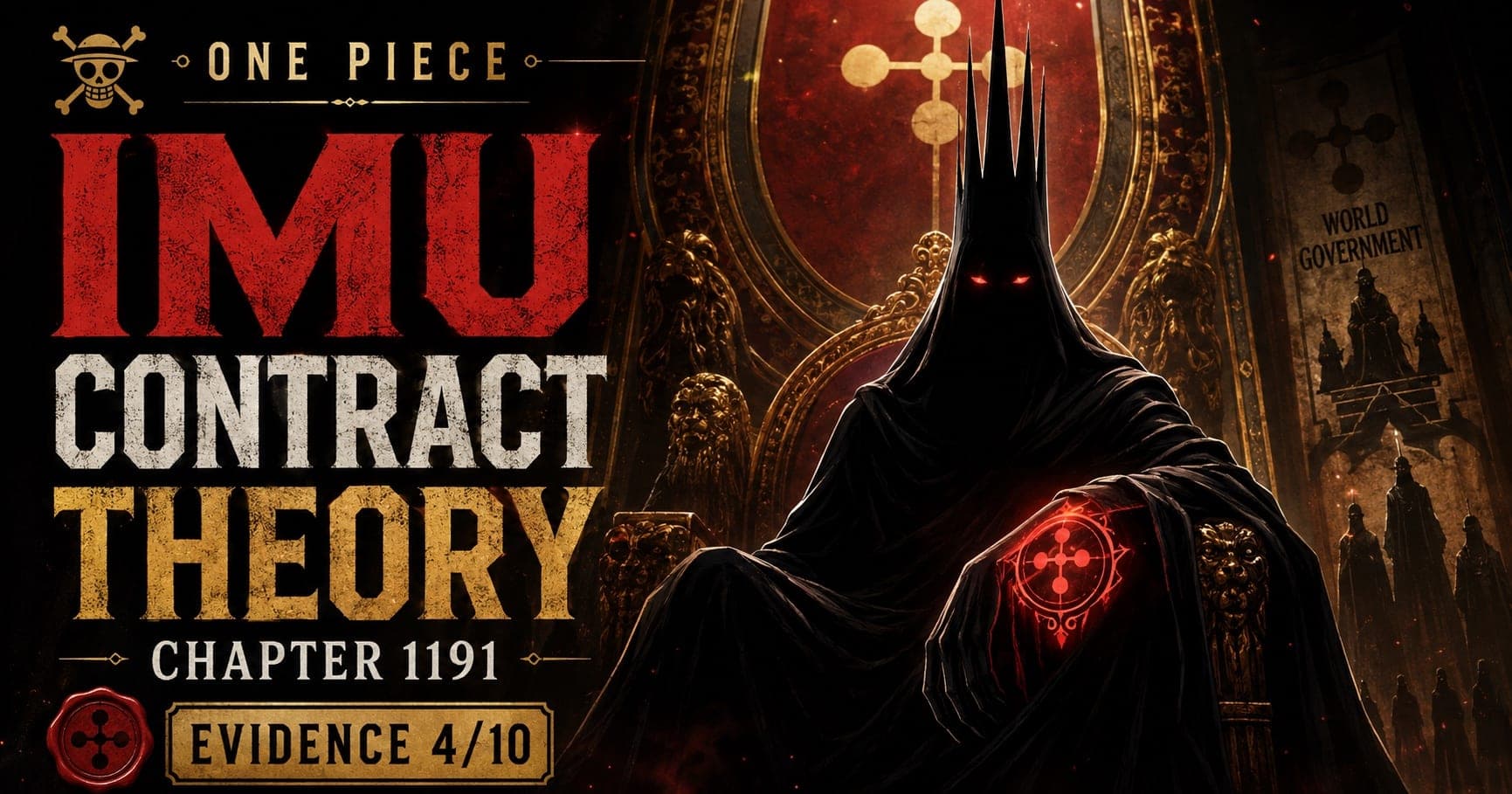
THEORY WATCH · SPOILER NOTICE — this piece discusses ONE PIECE chapter 1191 in full, including Imu's current form on Elbaf. Chapter 1191 ran in Weekly Shonen Jump issue 39, on sale 24 August 2026 — the issue Shueisha's own listing gives ONE PIECE the cover and lead colour pages in. Chapter 1192 is not out: Shueisha's listing for issue 40, on sale 31 August 2026, states outright that ONE PIECE is on break, and the series is scheduled to return in issue 41 on 7 September 2026. Everything below is written against the published chapter only.
Chapter 1191 may have introduced a small visual detail with enormous implications — but only if the mark on Imu means what some readers think it means. (We write the name as Imu here, the form English-language readers search for; our earlier pieces use the shorter Im. Same character, 「イム」.)
Heat / Freshness
HIGH / HIGH
- Posted within hours of the 24 August 2026 release
- Amplified the same evening by Japanese discussion round-ups
- Chapters 1192 and 1193 have since published without settling it — the window is still open
Evidence
4/10
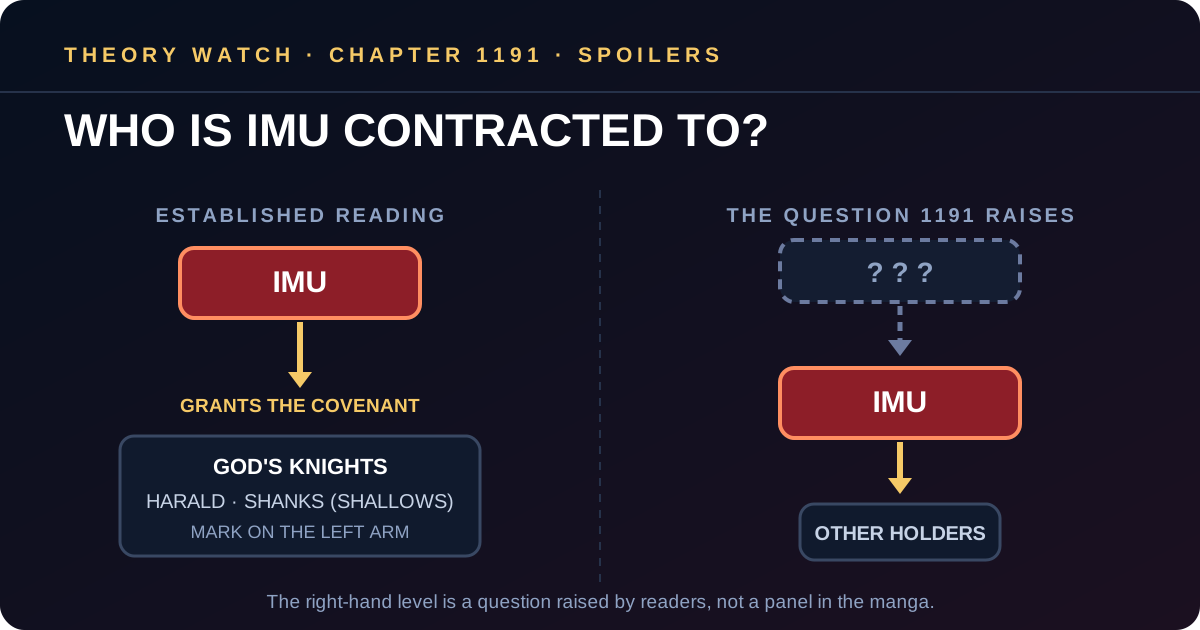
- The covenant system and its arm marks are canon
- That Imu's arm carries that specific crest is a reader reading
- Nothing on the page puts an authority above Imu
1. What the manga actually establishes about the contract system
The covenant system is not fan invention. It is one of the more carefully specified pieces of machinery in the endgame, and it comes with rules.
Contracts arrive in three named tiers — the shallow-sea, deep-sea and deep-deep-sea covenants — with power scaling as they go down. The shallowest is enough on its own to make defiance impossible inside Imu's range, which Shanks spells out in chapter 1169. The deeper tier adds the things that make the God's Knights what they are (and what breaks them): strength beyond a human body, wounds that close, movement through the Abyss, and obedience that reaches the holder wherever they are. The deepest tier belongs to the Five Elders, and the number of people who can hold the two deeper grades at once is small and fixed.
Two details matter for everything that follows.
First, holders carry a mark, and it sits on the left arm. It reads as the World Government's symbol pulled out of shape, and the deeper grade adds a horn to that design. Harald received one. Shanks carried the shallowest version, which is why his left arm has been the subject of a decade of argument.
Second — and this is the part the new theory has to get past — granting a contract is something Imu does as a named ability. Chapter 1150 shows it happening: working through Gunko's body, Imu binds Dorry and Brogy with it. The contract is not an institution Imu belongs to. It is a technique Imu performs.
2. The mark that started the theory
Chapter 1191 escalates Imu's form again. The body bulks out, the hair rises, the horn count goes up, and both arms turn black. Multiple Japanese reviewers on release day compared the silhouette to the demon painted in Elbaf's murals.
On that blackened arm, some readers say there is a crest.
The claim went up on X on 24 August 2026, hours after the issue: the arm carries the deep-sea covenant's emblem. By the same evening a Japanese discussion round-up was carrying it under the headline that a being above Imu was being hinted at — and carrying the first objection to it in the same breath. The reasoning is one short step: if a covenant mark is on Imu, somebody issued it.
We have to be precise about the status of that observation. It is a reader's reading of one panel, and it is not universal. Two of the detailed Japanese chapter reviews we use for 1191 describe the same transformed arms and never mention a crest at all — one of them describes the blackened arms as carrying Imu's demonic aura — 魔気, the word the arc uses for Omen — like bracelets, an armlet of energy rather than a stamp. Both readings are looking at the same black arm and the same white shapes on it.
でも、そのイム様の腕にはなぜか「深海契約」の紋章がある!?
But for some reason there's the crest of the Deep Sea Covenant on Imu's arm?!
おそろいにしてるだけじゃなくて?
Isn't it just that they're matching?
腕も真っ黒に変化して魔気が腕輪のようについています
The arms turn pitch black too, with the demonic aura sitting on them like bracelets.
3. Why some readers think Imu is contracted too
The appeal of the reading is that it slots into an argument that predates chapter 1191. A note.com post from 23 April 2026 had already proposed that the Imu we see may not be the whole of Imu — that the figure on Elbaf and the silhouette in the flower room behave like two entities with mismatched knowledge, and that Imu may be riding a body rather than inhabiting one. Chapter 1150's possession of Gunko is the precedent that makes this thinkable rather than absurd.
Set that alongside a covenant crest on Imu's arm and the theory almost writes itself: the thing on Elbaf is a contracted vessel, and something else holds the leash.
The X post that started the run actually goes there — it suggests the weakened Imu currently on the page might be a decoy or a doubled body. That is a bigger claim than "Imu has a contract," and it is worth keeping the two separate, because they need different amounts of evidence.
4. If Imu answers to something, what could it be?
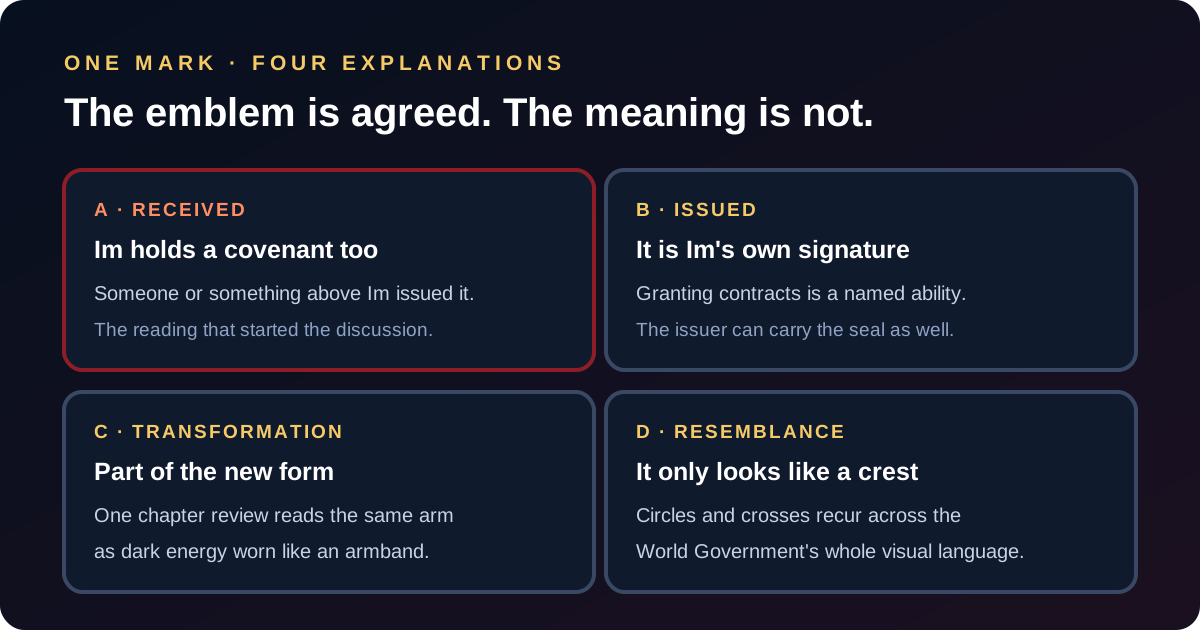
Four candidate shapes, in descending order of how much the story would have to invent.
A. A power or system rather than a person. The most economical version. Imu's abilities are explicitly transactional — lifespans traded, obedience purchased — and a system that takes payment does not need a face. Nothing would need to be introduced; the cost would simply be revealed.
B. An ancient entity. Elbaf's murals give the story a demon and a sun god, and 1191's form is being compared to the demon by readers on both sides of this argument. A pact with something out of that iconography is thematically available. It is also entirely undrawn.
C. Another individual. The version that gets the headlines and the one the page supports least. Nobody has been shown giving Imu a condition, a deadline or an order. Gaban, asked in this very chapter what Imu is, reaches for "a god" — which is characterisation of Imu's standing, not evidence of a rank above it.
D. A symbolic misunderstanding. The mark is the issuer's own seal, or part of the transformation, or a circle-and-cross shape in a world thick with circle-and-cross shapes. This is where the first Japanese objection landed, in four words: isn't it just that they're matching?
5. The Blackbeard three-skull connection
This one gets bundled in, and it should not be. The skulls on Imu's torso get read as an echo of Blackbeard's three-skull jolly roger, which would make the markings a record of enemies rather than a contract.
We already went to the chapter on this for our Theory Radar, and it did not survive the trip. The torso does not carry a legible trio; it carries a dense mass of many small skulls worked into the body. The reading also depends on Blackbeard being Rocks' son, which Japanese discussion treats as near-settled but which is not confirmed. Low confidence, and it does not support the contract theory in either direction.
6. The strongest counterargument
The theory's whole load sits on one inference: the same mark implies the same relationship.
It does not. An emblem can mark the party who grants a thing as easily as the party who receives it — that is what a seal is. Imu performs the contract as a technique; a symbol that appears on the person using an ability is the ordinary case in this manga, not the strange one. And there is a plainer possibility still, which is that the shapes on that arm are the transformation, not a tattoo: the aura visibly changes Imu's arms in this chapter, and at least one careful reader described exactly that.
Add the positional problem. The covenant mark is a left-arm mark on human-shaped recipients. In 1191 both of Imu's arms are altered, on a body that is no longer human-shaped. Any claim about which arm carries which tier's crest is being made about a figure whose anatomy the chapter has just rewritten.
FACT — established by the manga
- Covenants come in three named tiers, and holders carry a mark on the left arm
- Imu grants them; Harald received one, Shanks carried the shallowest
- Granting the contract is a named ability Imu performs
- Chapter 1191 gives Imu a further transformation with blackened arms
THEORY — still unsupported
- That the marking on Imu's arm is a covenant crest
- That Imu receives covenants rather than only issuing them
- That a named individual sits above Imu
- That the skull motifs point at Blackbeard