Quick answer: who can use internal destruction Haki?
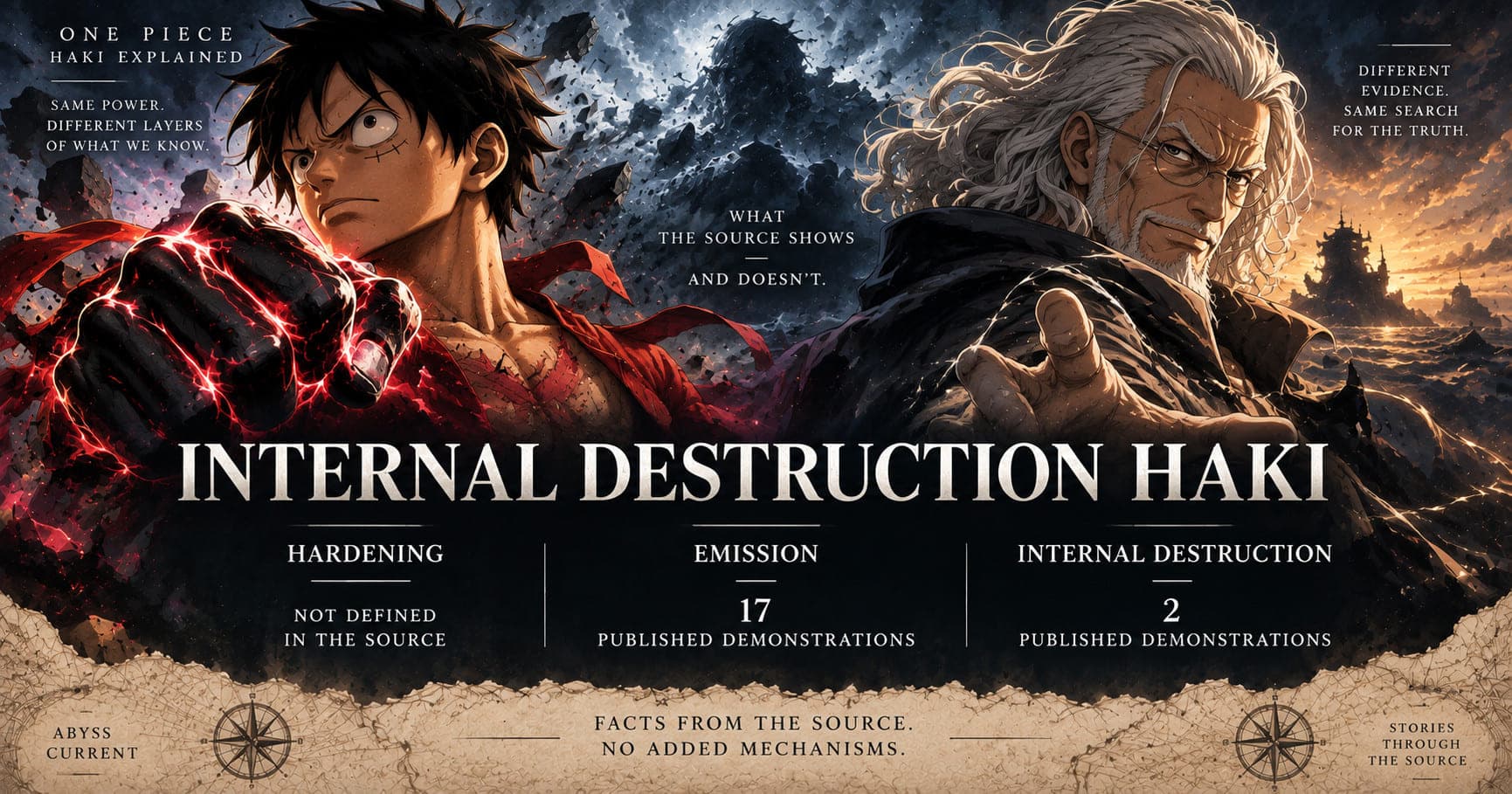
Two characters have a published demonstration of it: Silvers Rayleigh and Monkey D. Luffy. That is the whole roster.
Internal destruction is a documented form of advanced Armament Haki with only two published demonstrations. Rayleigh removes Camie's exploding collar in chapter 504. Luffy destroys a collar the same way in chapter 947, in a sequence that ties the technique back to that earlier moment, with Hyogoro explaining it as sending Haki inside a target and breaking it from within.
Almost every other name you will see attached to it comes from a different record. Hyogoro teaches the technique, and his own published demonstration is emission. The Yonko appear on the emission record, where they appear at all. Mihawk has no published demonstration of emission or internal destruction. And "they use Ryuo" is not an argument, because Ryuo is Wano's word for Armament Haki in general, basic coating included.
Evidence level:
CHAPTER-REFERENCED. Every manga claim here is traced to the published record through published-chapter references, not re-read from the page for this article. Where a chapter number exists for a claim we give it; a few roster feats are recorded without one, and we do not invent locators for them. One claim is not chapter evidence and is marked where it appears: Hyogoro being described as the master who teaches Ryuo comes from Shueisha's character page, which isOFFICIAL SUPPLEMENTARY— useful, and never used to overrule a chapter. Where something rests on an inference we say so in the same sentence. No leaks, no raw scans, no anime-only or film-only material. This piece is the deep dive behind one row of our strongest Haki users ranking.
What the source actually distinguishes
The chapters keep three uses of Armament Haki apart, and this page follows them. What separates them here is not how strong each one is. It is how much the source says about each one, and how many characters it shows doing it.
| Application | Demonstrations | Source says | Not established |
|---|---|---|---|
| Hardening | Everyday use, no roster | Coats body or weapon | A gated roster |
| Emission | 17 characters | Named, feats on page | One stated mechanic |
| Internal destruction | 2: Rayleigh, Luffy | Breaks a target from within | Fight value; order vs emission |
Read the table across, not down. The rows are not rungs. The chapters we reference do not say that one of these contains another, or that a character who shows one has passed through the others first. Rayleigh and Luffy appear on both the emission and the internal destruction records; that is a fact about those two characters, not a rule about the techniques.
Hardening — what is documented, and what is not defined
Coating the body or a weapon in Armament Haki is the ordinary use of the branch throughout the series. That much is documented, many times over.
What the source does not do is define hardening as a gated technique with its own roster, the way it does for internal destruction. So this page does not count hardening users, and it does not treat hardening as a starting point that every emission or internal destruction user is shown passing through.
Emission — published demonstrations
Published emission users: Sentomaru, Boa Marigold, Kuzan, Sakazuki, Borsalino, Rayleigh, Hyogoro, Kawamatsu, Luffy, Roger, Whitebeard, Oden, Kaido, Big Mom, Garp, Koby and Doll.
The feats on that record are not all the same shape — Whitebeard bisecting a God's Knight in passing (ch. 1161), Kaido sustaining an untouchable flame-form, Rayleigh hurting Kizaru through a Logia body. We are not going to reduce that to a one-line mechanic the chapters have not given.
Note who is on the list. Sentomaru and Koby are. Several characters routinely ranked far above them are not. That is not a claim that Koby outclasses those characters — it is what happens when the gate is a published demonstration of a specific application rather than a general sense of who is strong.
This is also where most of the names misattributed to internal destruction actually belong.
Internal destruction — two published demonstrations
The technique is described in Wano, during Luffy's training, and the description is unusually concrete for this series: Hyogoro explains it as sending Haki into a target so that the target is broken from within. That is the one mechanic on this page, and it comes from the chapter, not from us.
It is what makes the technique legible on the page. In chapter 504 Rayleigh removes Camie's exploding collar without setting it off. In chapter 947 Luffy destroys a collar the same way, and the chapter ties it back to Rayleigh's moment. It is not "a very strong punch." It is a different verb.
Demonstrated internal destruction
- Silvers Rayleigh — ch. 504
- Monkey D. Luffy — ch. 947
Frequently listed, not demonstrated
- Hyogoro — teaches the technique; his own published demonstration is emission
- The Yonko as a group — emission, where they are on the record at all
- Mihawk — no published demonstration of emission or internal destruction
- Anyone credited on the strength of a Black Blade
Silvers Rayleigh — chapter 504
Evidence: CHAPTER-REFERENCED · Confidence: High.
Rayleigh removes Camie's exploding collar without setting it off. That is the demonstration the series later points back to.
One correction worth making, because it is the most common way this entry gets supported badly: Rayleigh's showing against Kizaru at Sabaody is a genuine Armament feat, but it belongs on the emission record — not this one. It should not be used to support this row, and we no longer use it.
Monkey D. Luffy — chapter 947
Evidence: CHAPTER-REFERENCED · Confidence: High.
Luffy destroys a collar the same way during his Wano training — our Haki ranking records it as practised on a tree and used in combat — and the chapter ties the technique back to Rayleigh's moment, with Hyogoro explaining it as sending Haki inside a target and breaking it from within.
Luffy is also on the emission record, through his counter to Kaido's untouchable flame-form. He and Rayleigh are the two characters with a published demonstration of both.
On ranking these two against each other: we do not. Rayleigh demonstrated it first and is the character the story teaches the concept through; Luffy has used it in combat and also holds the Kaido emission feat. Those are different records, not a hierarchy, and inventing a tiebreaker the story has not provided is exactly the failure mode this page should avoid.
Frequently listed, not demonstrated
Hyogoro
The most understandable mistake on this page, because he is the one explaining the technique.
Hyogoro teaches Luffy the technique, in the Wano vocabulary, and the lesson is where internal destruction is spelled out. But teaching a technique and having a published demonstration of it are different records. Hyogoro is shown demonstrating emission, so he is on the emission record, not this one.
The Yonko, as a group
Kaido, Big Mom and Whitebeard get swept onto internal-destruction lists on the general principle that the strongest characters must have the strongest version of everything. The published record does not work that way. All three appear on the emission record instead — real feats, but not this technique. Shanks is a separate case again: his advanced Haki record is in the Conqueror's branch, and no emission or internal destruction is recorded for him at all.
Mihawk
This will read as an omission, so here is the methodology in full: Mihawk has no published demonstration of emission or internal destruction. That is a statement about the record, not about him — we are not claiming he is a weak Armament user.
The Black Blade deserves the same treatment. It is frequently cited as proof of elite Armament Haki, and the causal link — that turning a blade into a Black Blade requires or demonstrates emission or internal destruction — is not something the story has established. So it does not count as evidence here. If that link is ever made explicit, this page changes, and the change log will say so.
Zoro
Zoro's Haki record is real and it is mostly in a different branch — an unconscious Conqueror's infusion in chapter 1033, applied in combat against King in chapter 1035, with the possession stated outright by Gaban in chapter 1152. None of that is emission, and none of it is internal destruction. We keep his case, and how unsettled it still is, in the Haki ranking itself.