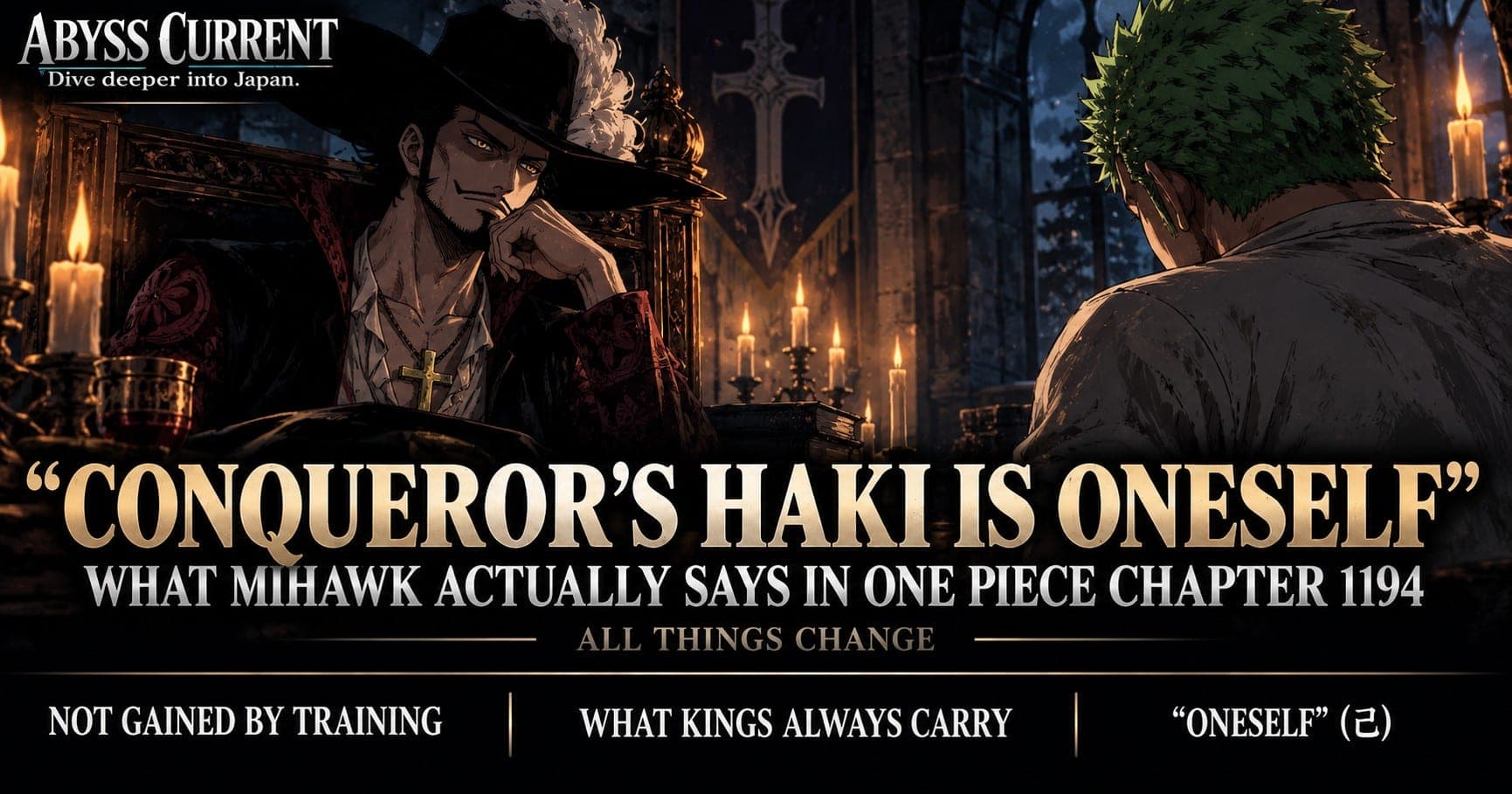
Quick answer: what does Mihawk say?
In a flashback to Zoro's training, Mihawk defines Conqueror's Haki in four lines:
- All things change — but one thing can stay unchanged. And he asks Zoro why.
- The other kind of Haki is not something you gain by training.
- It is the one unchanging thing that kings always carry.
- Remember: Conqueror's Haki is "oneself" (己) — strong enough that the weak cannot stand.
That is the whole of it on the page. The chapter uses the first line as its title — 「万物は変わりゆく」, all things change — and places the last line on its final page, around Zoro's three-sword stance.
Evidence: PRIMARY — MANGA VERIFIED for chapter 1194, read directly from the official Japanese release on Shonen Jump+. Other chapters are CHAPTER-REFERENCED. English wording is our paraphrase of the Japanese, not the official translation.
The scene
The lines come in a flashback threaded through Zoro's fight with Sommers — the training period with Mihawk, framed by a dinner-table panel with Perona and Zoro present. The flashback is not given a date in the chapter.
The sequence also carries two asides: someone suggests the unchanging thing might be a beard, and a Luffy panel — you didn't know? It's leaking out all over! — sits in the same run. They lighten the scene; they do not change what Mihawk says.
In the present-day fight around it, Zoro has just landed one strike that Sommers identifies as Conqueror's-coated and then lost it again. Our chapter 1194 report has the fight; this piece on why he cannot repeat it separates the evidence layers.
What the four lines establish
Taken strictly, as statements in dialogue:
- Mihawk treats Conqueror's Haki as different in kind from the Haki you train. "The other Haki" is set apart from the Armament and Observation work that makes up most of a swordsman's training.
- He ties it to kings. Not to strength in general, and not to swordsmanship.
- He names it "oneself." The Japanese is 己 — the self, one's own being. He adds that it is strong enough that the weak cannot stand, which matches the most familiar effect of Conqueror's Haki on the page: weaker people collapsing.
What the lines do not do is give a mechanism. "Oneself" is a definition offered by a character, not a rule the narration states.
How it sits beside other statements
Mihawk is not the first character to talk about what Conqueror's Haki is. Set side by side, the statements the series has given so far:
| Speaker | What they say | Layer |
|---|---|---|
| Mihawk (ch. 1194) | Not trained; kings carry it; "oneself" | PRIMARY |
| Rayleigh | Controllable; not trained stronger; grows with the person | CHAPTER-REFERENCED |
| Gaban (ch. 1152) | Zoro has it; must learn to control it | CHAPTER-REFERENCED |
What is on the record: all three agree that Conqueror's Haki is not something you simply drill into existence. Rayleigh and Gaban both separate having or growing it from controlling it.
Our reading — THEORY: read together, the three statements suggest a split the chapters have not stated outright — that the Haki itself is tied to the person and cannot be trained up, while control of it is something that can be learned. That would fit Zoro's position exactly: he has it, and cannot yet call it up. It is a reading of three separate lines, not a rule any of them states.
Three readings of "oneself" — THEORY, not confirmed
THEORY 1 — conviction. "Oneself" as self-assurance: Conqueror's Haki answers to how fully a person stands behind who they are. Support: it is the most common way the fandom reads Conqueror's Haki, and it fits "the weak cannot stand." Against: Mihawk does not say "will" or "conviction"; he says 己.
THEORY 2 — against "captain." In the same chapter Zoro thinks he had assumed the power only lodged in someone who captains a crew. Mihawk's "oneself" answers that on its face: it is not a captain's thing, it is a self. Support: the two lines sit in the same chapter. Against: the chapter never puts them in conversation.
THEORY 3 — the title. All things change; one thing stays unchanged. The chapter pairs the changing world with an unchanging self, and ends on Zoro's three-sword stance with black lightning-like effects drawn around it. Support: the structure of the chapter. Against: structure is not statement, and no strike is shown.
What chapter 1194 does not settle
- Whether Mihawk has Conqueror's Haki. He defines it; the chapter does not say he possesses it.
- When the flashback happens beyond "during Zoro's training with Mihawk."
- Whether the lesson is what produces Zoro's last-page stance. The black lightning-like effect is not named on that page, and no strike is shown.
- A mechanism. "Oneself" is Mihawk's word, not the narration's rule.
What to watch in chapter 1195
ONE PIECE returns in Weekly Shonen Jump issue 46, on sale October 13. The useful evidence would be the last-page effect identified as Conqueror's Haki, what the strike that follows does to Sommers, and — above all — whether Zoro can do it again, on purpose.
Read next
- Does Zoro have Conqueror's Haki? Every chapter it shows up
- Why can't Zoro repeat Conqueror's Haki? What chapter 1194 actually shows
- Zoro Lands One Conqueror's Haki-Coated Strike — Then Can't Repeat It (chapter 1194)
- Strongest Haki users in ONE PIECE, ranked — where Rayleigh's statement on Conqueror's Haki is recorded.
Change log
- 28 September 2026 — Published.
- 5 October 2026 — Corrected the last-page description after a full-resolution re-read of p.85: Mihawk's 「"己"だ」 sits on a page that ends with Zoro's three-sword stance, not a strike. "Final strike" wording replaced.