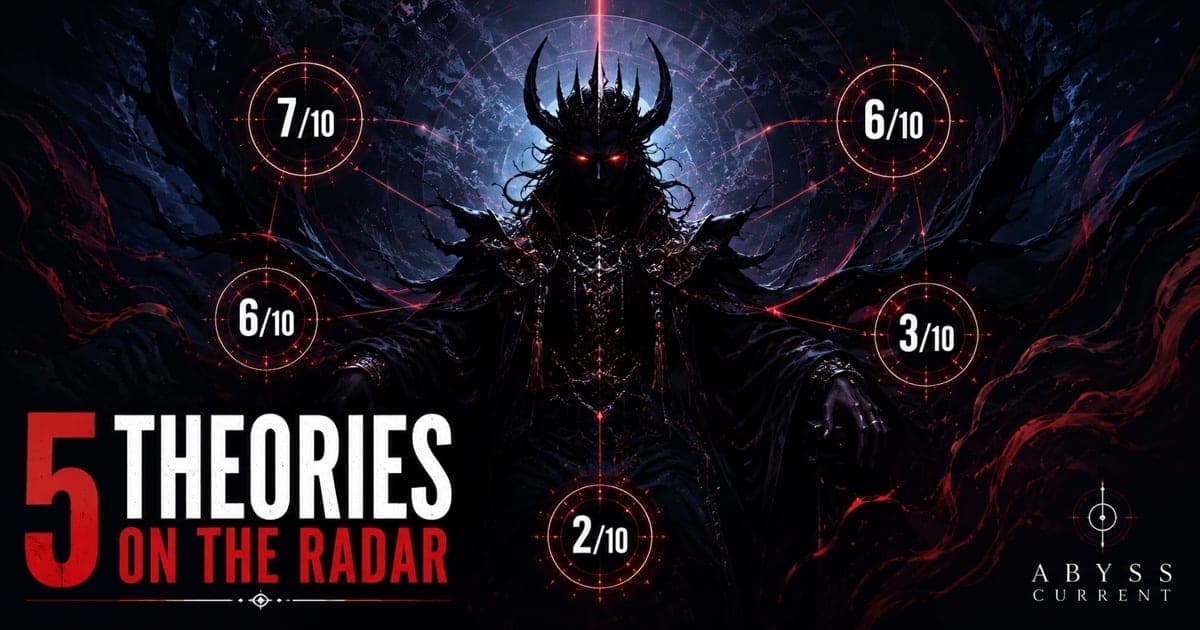
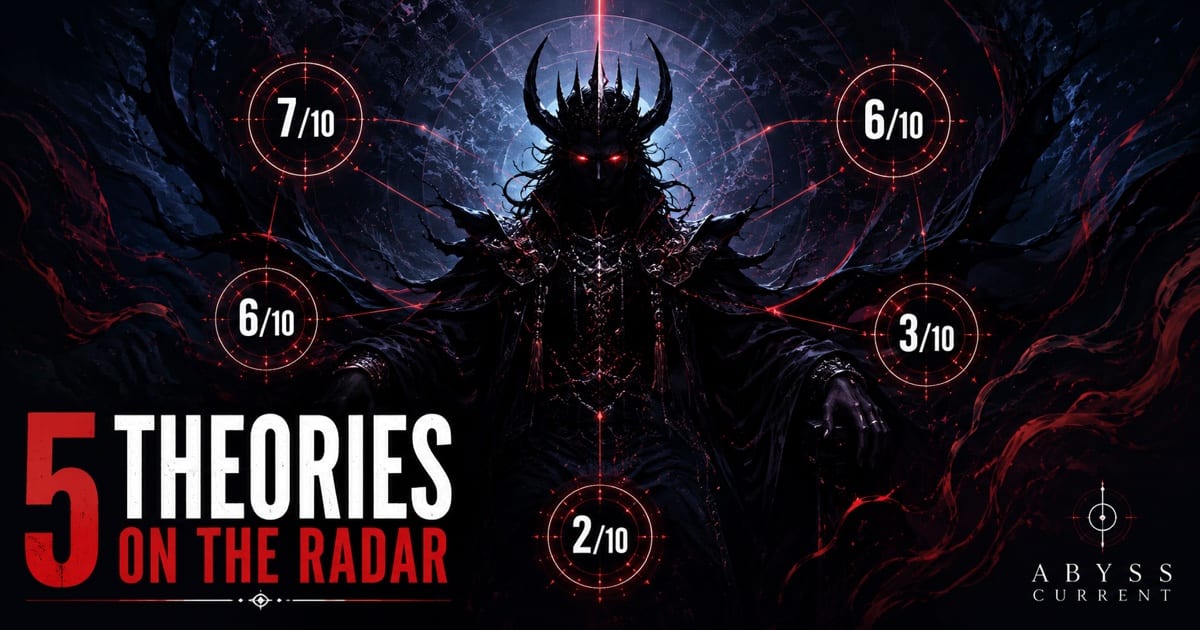
5 Japanese ONE PIECE Theories We're Tracking Right Now
Five unresolved theories from Japanese-language ONE PIECE discussion, scored on how well the published evidence actually supports them — not on how likely they are to happen.
By ABYSS CURRENT Editorial···14 min readShare on X
Artwork: ABYSS CURRENTIn this article+
This is the first scored edition of Theory Radar. Everything below is unconfirmed, and we are not predicting which of these will happen.
What we are doing is different, and it is the point of this format. We are not a place
that repeats theories. We take the arguments Japanese readers are actually making, go
back to the manga, and check whether the evidence is there.
Sometimes it is not. Two of the five below lost evidence during this edition, because we
read the chapter instead of the summary of it. One of them was demoted twice. That is not
a failure of the format — it is the format. A radar that only ever confirms is a
newsletter with extra steps.
Current as of chapter 1191, read in Weekly Shonen Jump 2026 issue 39.
Five theories, one rule: we score what survives a check against the manga, not what feels exciting. Artwork: ABYSS CURRENT
WE CHECK THEORIES AGAINST THE MANGA
Theory
Confidence
Heat
Load
Contra.
Score
Im is not human
HIGH
HOT
MEDIUM
LOW
7/10
Oda's oldest withheld secret is the title itself
HIGH
COOL
LOW
LOW
6/10
God Valley is where the endgame's foundations get laid
HIGH
HOT
MEDIUM
LOW
6/10
Im's body is a record of what Im has destroyed
LOW
COOL
MEDIUM
MEDIUM
3/10
The treasure and the truth are two different things
MEDIUM
COOL
HIGH
LOW
2/10
Five theories, scored on the evidence behind them rather than on how likely they feel.
The rubric is below; the theories themselves follow it.
How the Radar Score works
A RADAR SCORE is an editorial evidence score. It is not a probability, and it is
not a prediction. It answers one question only: how well is this theory supported by
the material available today? A well-built theory can still be wrong, and Oda has a
long record of paying off the reading nobody rated highly.
The same rubric is used every time, so scores stay comparable across editions.
Evidence (0–10) — what the theory actually rests on.
9–10 — stated outright in the manga or in official material; only the interpretation is open
7–8 — named techniques, dialogue or on-page events that need no visual guesswork
5–6 — on-page details that require a specific reading before they become evidence
3–4 — visual resemblance, naming patterns or panel details that could be coincidence
0–2 — nothing you could point at
Independent Signals (0–10) — how many separate details point the same way. One
detail read four ways is one signal.
8–10 — four or more unrelated details converge
6–7 — two or three
4–5 — one detail, with a second party independently reaching the same place
0–3 — one detail, one source
Assumption Load — unproven steps the theory needs to stand up.
LOW = none or one. MEDIUM = two or three. HIGH = four or more, or any single step whose
failure collapses the whole chain.
Contradictions — how much existing material argues against it.
LOW = nothing on the page pushes back. MEDIUM = something does, but it is explainable.
HIGH = the manga or official material says otherwise.
THE FOUR AXES→THE ARITHMETIC
The score.round(Evidence × 0.6 + Independent Signals × 0.4), minus a penalty of 1
for a MEDIUM in either Assumption Load or Contradictions, or 2 for a HIGH. The worst of
the two applies; they do not stack. The arithmetic exists so that the difference between
a 7 and a 6 is a stated reason rather than an editor's mood.
Theories are ordered by score. That is not a ranking of likelihood.
THEORY 01
Theory #1 — Im is not human
ABYSS CURRENT RADAR
Im is not human
7/10
Evidence8/10Horns, wings, arms and a named attack, read in the issue, not on panel-squinting.
Independent signals7/10Anatomy, technique naming and Gaban's answer are separate details pointing away from "human".
Assumption loadMEDIUM"Non-human" is nearly free; "demon race specifically" costs more.
ContradictionsLOWBut Gaban's god line is a real one.
The claim. Im is not a human being with a Devil Fruit. Im belongs to a non-human lineage — Japanese posts call it 悪魔族, a "demon race" — that once existed alongside humans, giants and fish-men, and has since been reduced to almost nothing.
Why Japanese fans think this. The reading took off after Im's transformations on Elbaf. The theory channel とーやチャンネル argued it on 25 August 2026, framing Im's species as a lost race in the same category as the Lunarians and the ancient giants — races the story has already established as effectively extinct — and floating Kaido as a possible relative. The same channel returned to it on 28 August 2026 with a more specific version, tying Im to a devil-king figure. That video is the most-watched Japanese theory upload of the past week we found.
The Japanese argument itself, embedded rather than paraphrased, so you can check our summary of it against the original. イム様とカイドウは同じ種族か…3代目知識王による最新話完全深掘り — とーやチャンネル【ワンピース大好きチャンネル】 · 25 August 2026
What supports it. This is unusually well anchored for a species theory, and the core of it is verified rather than reported. We read chapter 1191 in the issue itself:
Im fights in a form with four horns, large black wings, and blackened clawed arms. Whatever that is, it is not a human being with a fruit power.
Im's attack in that form is named 骨喰み — bone-eating. Techniques get named after what they are.
Asked what Im is, Gaban answers god — a word for something outside the human order, even though it is not the word this theory wants.
Two further details are cited constantly in Japanese discussion and we flag them as
reported, not verified: that chapter 1179's naming of Im's fruit breaks the series'
own convention, and that chapter 1180 names Im's technique with a demon character. Both
are older chapters we could not reach in the archive. If they hold, they push this
further; the case above does not depend on them.
What works against it. Two things, and neither is small.
The first is Gaban, and we checked this one in the chapter itself. Asked what Im is, he refuses the question — nobody should know — and then concedes: if a word has to be put to it, the word is god. He does not say demon. That is the only in-text answer to the question so far, and it points the other way.
The second is the Lunarian precedent. The story has already shown a race with wings and fire that was worshipped as gods and was still a race of people, not demons. Everything cited above is compatible with Im being the last of something like that. "Not human" is much better supported than "demon."
THEORY 02
Theory #2 — Oda's oldest withheld secret is the title itself
ABYSS CURRENT RADAR
Oda's oldest withheld secret is the title itself
6/10
Evidence7/10A dated, published statement by the author.
Independent signals4/10Essentially one source, repeated.
Assumption loadLOWThe claim is only that a secret exists.
ContradictionsLOWNothing argues against it.
The claim. The meaning of the words One Piece — why the series is called that — is a deliberate, still-unspent reveal, not a naming accident.
Why Japanese fans think this. This one is sourced to Oda rather than to the manga. In a video published on 23 August 2026, とーやチャンネル went back to the 2002 official databook ONE PIECE BLUE and pulled question 37, which asks Oda whether he has a secret nobody around him knows. His answer names the secret of the title's naming. That is 2002. Twenty-four years later it has not been explained.
What supports it. The source is a published official databook, not a rumour, which makes this one of the few "theories" on the list with a documentary basis rather than an inferential one. Oda chose to flag the title as a secret at a point when the series was seven volumes in and could easily have been renamed to avoid confusion with the garment. He kept it and flagged it. That is a strong signal that the phrase carries something.
What works against it. The signal is strong; the content is empty. Knowing a secret exists tells you nothing about what it is, which makes this theory nearly unfalsifiable until the ending lands. It is also possible the answer is a small joke rather than a structural reveal, and that a 2002 quip has been inflated by twenty-four years of anticipation. Treat it as a reason to expect a reveal, not as evidence for any particular one.
THEORY 03
Theory #3 — God Valley is where the endgame's foundations get laid
ABYSS CURRENT RADAR
God Valley is where the endgame's foundations get laid
6/10
Evidence7/10An official announcement plus a verified line in the newest chapter.
Independent signals7/10Shanks, Rocks, Im, Gaban and the film slate arrive at it separately.
Assumption loadMEDIUM"Important" is safe; "reframes the endgame" is not.
ContradictionsLOWNothing on the page argues against it.
The claim. The God Valley incident is not backstory being tidied away. It is the load-bearing event of the final act, and the material still to come from it will reframe Im, Rocks, Garling and the Figarland line.
Why Japanese fans think this. This one has an unusual kind of support: a release schedule. On 23 August 2026 the official site announced two films — ONE PIECE FILM GOD VALLEY for summer 2027, timed to the manga's thirtieth serialisation anniversary on 22 July 2027, and ONE PIECE FILM BAAD for 2029, timed to the TV anime's thirtieth anniversary on 20 October 2029. Neither has a synopsis. Japanese theory coverage in the days after treated a God Valley film as a signal that the incident is being expanded rather than closed.
Toei's teaser for ONE PIECE FILM GOD VALLEY, summer 2027. A publisher does not schedule a feature around an incident it considers finished — this is the announcement the theory rests on. ONE PIECE|映画|超特報 — ONE PIECE公式YouTubeチャンネル · 23 August 2026
What supports it. God Valley keeps being used rather than referenced, and the newest chapter uses it directly. We read chapter 1191: mid-fight, Im recognises the Roger crew, then names the children who were at God Valley and says it could not have been predicted that they would turn out the way they did. Whatever else Im is doing on Elbaf, the story has Im thinking about that generation, on the page, right now. Shanks' origin runs through the same event. Rocks' end runs through it. The Figarland line runs through it. And a publisher does not schedule a feature film around an incident it considers finished.
What works against it. A film is a commercial decision, not a plot statement, and ONE PIECE films have historically sat beside the manga rather than inside it. A God Valley film could adapt what is already known without adding anything the manga will treat as canon. Anniversary timing is also its own explanation: both films sit on round-number dates, which is a scheduling reason before it is a story reason. And summer 2027 is a long wait for a test, which is a weakness in a format that values checkability.
THEORY 04
Theory #4 — Im's body is a record of what Im has destroyed
ABYSS CURRENT RADAR
Im's body is a record of what Im has destroyed
3/10
Evidence4/10The transformation is verified; every specific detail read into it failed or is unchecked.
Independent signals3/10Both cited signals came apart against the page.
Assumption loadMEDIUMThe "trophy" mechanism is inferred, never stated.
ContradictionsMEDIUMThe chapter contradicts the dialogue as quoted and does not show the skull trio.
The claim. The markings that keep appearing on Im's escalating forms are not decoration. They are taken from the people Im has erased — and the two most legible ones point at Rocks D. Xebec and his line.
Why Japanese fans think this. The most detailed version came from スーパーカミキカンデ on 26 August 2026, a channel whose operator has credits on official ONE PIECE reference material. The argument, working from chapter 1191's new form: the mark now running through Im's left eye closely resembles the facial marking on Rocks D. Xebec, whose face was revealed back in chapter 1154; and the skulls on Im's chest echo the three-skull jolly roger of Blackbeard, who is widely read as Rocks' son. The video's extension is that Im's body is an eight-hundred-year record of what it has put down.
The video whose two central claims we went to the chapter to check. Both came apart there, which is why this theory scores 3. 【ワンピース最新話】イム様の目にロックスと同じマーク?!ドクロは黒ひげ? — スーパーカミキカンデ【ONE PIECEが大好きな神木】 · 26 August 2026
What supports it. One thing, and it is real. We read chapter 1191 in the issue itself, and the form is on the page: Im fights in a shape with four horns, black wings and blackened, clawed arms, with skull motifs worked across its torso. Something about Im's body is accumulating detail as the fight escalates. That much is not in dispute.
What works against it. Checking the chapter went badly for this theory — twice.
The skulls on Im's torso are not a legible trio echoing a jolly roger. They are a dense mass of many small skulls worked into the body itself. Read as "Im is covered in the dead," that is evocative. Read as "these are Blackbeard's three skulls," it does not survive looking at the page.
The dialogue does not hold either. The line we were sent to check is not what Im says. On the page Im recognises the Roger crew, names the children who were at God Valley, and says it could not have been predicted that they would turn out that way. It is regret about underestimating that generation. Rocks is not mentioned in it. The version circulating in secondary coverage — that Im should have erased them alongside Rocks — is not the line that was printed.
What remains is one unverified visual resemblance between two facial markings, which is the kind of resemblance that becomes obvious once you are looking for it. The Rocks-to-Blackbeard family link the argument leans on is also still being debated rather than settled.
The same chapter's markings produced a second, separate reading a fortnight later — that one of them is a covenant crest on Im's own arm. We took that one apart in Who Is Imu Contracted To?.
THEORY 05
Theory #5 — The treasure and the truth are two different things
ABYSS CURRENT RADAR
The treasure and the truth are two different things
2/10
Evidence5/10The constraints are canon; the conclusion is not.
Independent signals3/10One chain of reasoning, one source.
Assumption loadHIGHMany steps, each load-bearing.
ContradictionsLOWNothing disproves it, which is partly the problem.
The claim. ONE PIECE is a physical object, and it is not the thing that explains the Void Century. The history is a separate item sitting on Laugh Tale next to it.
Why Japanese fans think this. The most systematic recent version came from 余白ノ考察 on 24 August 2026, which starts by listing what the manga has actually committed to about the treasure — that it is on Laugh Tale, that it is a real object rather than a metaphor, that it is genuinely enormous, that the Roger Pirates laughed at it, and that finding it turns the world over — and then argues the last item is not a property of the object at all. Whitebeard's line ties the world turning over to the enormous war that follows, not to the treasure's contents. And the text says Roger's crew learned everything on arriving at Laugh Tale — which implies the knowledge and the treasure are separate finds.
What supports it. The separation argument is genuinely good, and it is doing something most treasure theories do not: narrowing by elimination against stated constraints instead of guessing at an answer. It also solves a real problem. Luffy is not motivated by history, and a treasure whose value is a history lesson sits badly with the character the series has spent thirty years building.
What works against it. The same video's actual conclusion — that the treasure is a colossal mass of honey to be brewed into mead and distributed by the Ark Noah, with Laugh Tale sitting on the seabed beneath Hachinosu — is an enormous stack of assumptions, built on flower-themed character names, a single English-language episode title, and an inverted reading of a line from Bellamy. Any one of those steps failing collapses it. It is also a single source; we found no independent Japanese line of argument reaching the same place.
We are scoring the theory as published, not just its first half. Run the separation
argument on its own — Evidence 6, Independent Signals 5, Assumption Load LOW,
Contradictions LOW — and it scores 6. The honey ending is what takes it to 2. We have
kept it on the list at 2 deliberately: a radar that only carries well-supported ideas
stops being able to show you the difference.
WHAT WE LEFT OUT
What we left out, and why
Three candidates did not make the list. A theory has to be traceable to a dated source that says what it is claiming and what it is claiming it from, and it has to still be open.
Anything the Elbaf material has already answered. A run of theories about Loki, King Harald and Elbaf's succession were live earlier this year and have since been answered on the page. We are not naming a single cut-off chapter for that, because there isn't one — the Elbaf material resolves in pieces across the run that Shueisha collects in volume 115 (chapters 1167 to 1179, published 3 July 2026) and after. Each candidate was checked against where its own answer landed rather than against a convenient boundary. Recycling a resolved theory as something to track would be dishonest.
Blackbeard as Rocks' son. Chapter 1154's reveal of Rocks' face moved this a long way, and much of Japanese discussion now treats it as effectively settled — but "effectively settled" and "confirmed" are different, and competing readings are still being argued. It sits in an awkward middle: too resolved to be a live theory, not resolved enough to cite as fact. It appears inside theory #3 as a dependency, flagged as one.
Popular theories we could not date. Several widely repeated ideas about Joy Boy and the Void Century turned out to trace only to undated aggregator pages that restate each other. Popular is not the same as sourced.
HOW WE SOURCED IT
A note on sourcing
Two kinds of claim appear above, and we do not want them confused.
Anything about what a theory says, and when someone said it is sourced to the dated
Japanese posts and videos listed below. Those are cited as proof that an argument exists
and was made on a given date — nothing more.
Anything about what the manga contains is held to a higher bar. For this edition we
read chapter 1191 in Weekly Shonen Jump 2026 issue 39, on sale 24 August 2026, rather
than relying on chapter summaries. That is where the chapter title, Im's four horns,
black wings and blackened arms, and the state of the skull motifs on Im's body come from.
It is also where we found that one widely repeated detail does not hold up — see theory
#4. Chapter numbering and titles up to 1179 are checked against Shueisha's own contents
listing for volume 115, and the film announcement against the official site.
Going back to the chapter changed two things. Gaban's answer about what Im is, and Im's
line about God Valley, are now verified — and the second one turned out not to say
what secondary coverage said it said, which cost theory #4 most of its evidence. Two
older details, from chapters 1179 and 1180, remain reported and unverified; they are
labelled as such above, and no score depends on them.
HOW TO CHECK US
How to check us
Every theory here becomes testable, and the next test has a date on it. Chapter 1191 ends
with a note that the series is off in the following issue and returns in Weekly Shonen
Jump issue 41, on sale 7 September 2026. Theories #1 and #4 move with the Elbaf
fight, so that is when they get their next look. Theory #3 has a scheduled test in summer
2027. Theory #2 resolves at the ending or not at all.
We will re-score these as chapters land, and we will say plainly when one of them dies. That is the part of the format that matters: a radar that only ever shows hits is not a radar.
For the fight these theories keep pointing back at, our ranking of the strongest Elbaf characters applies the same evidence-versus-scaling split to the combatants themselves.