What Is Shanks' Strongest Attack in ONE PIECE? Only One Has a Name
What is Shanks' strongest attack? Divine Departure — Kamusari — the Conqueror's Haki slash he inherited from Roger, used in chapter 1079 to drop Kid and Killer in one blow. It is also the only attack of his the manga has ever named.
By ABYSS CURRENT Editorial···14 min readShare on X
Artwork: ABYSS CURRENTIn this article+
Short answer: Shanks' strongest attack is Divine Departure — 神避 Kamusari in the original — a sword strike infused with Conqueror's Haki, inherited from Gol D. Roger, which Shanks used in chapter 1079 to take down Eustass Kid and Killer in a single blow.
That is the answer every explainer gives, and it is correct. It is also incomplete in a way that matters, because Kamusari is not just Shanks' strongest attack. Through chapter 1191, it is the only attack of his the manga has ever named.
Covers published chapters through 1191. Chapters 1192 and 1193 have since been published and are not folded into this piece yet; nothing in them changes the attack analysis below. This piece uses published chapters only — no leaks, no raw scans — and separates manga material from guidebook and film material throughout.
Every ability attributed to Shanks, sorted by source
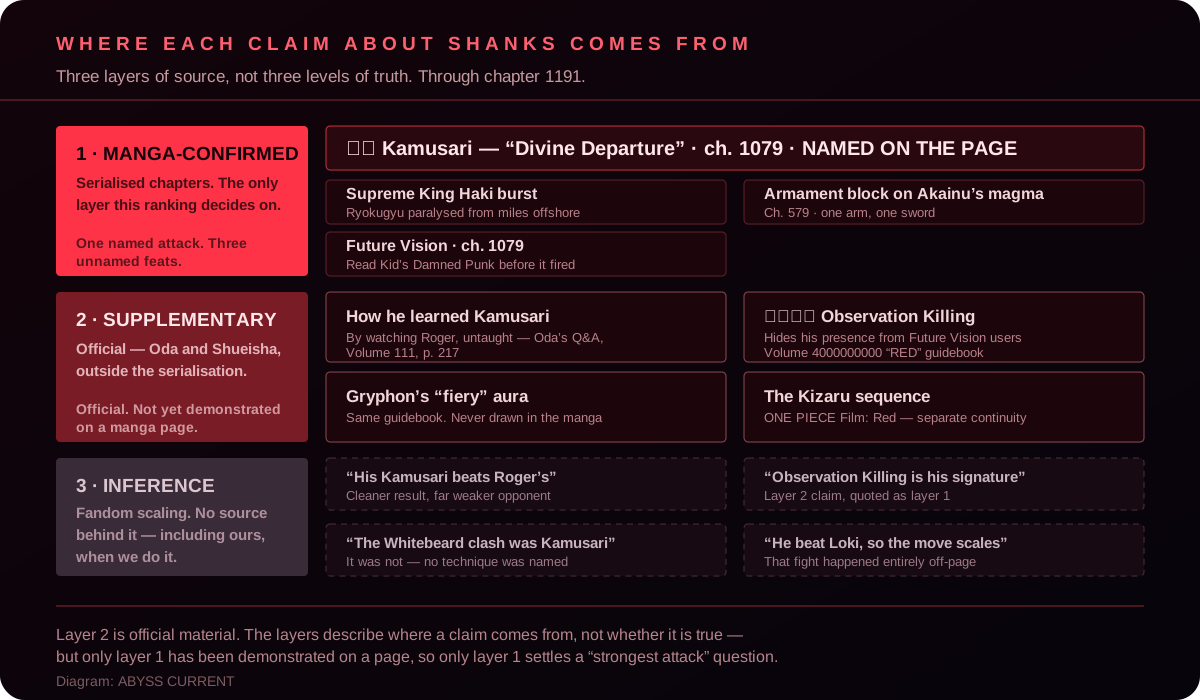
Before ranking anything, it is worth seeing where the information comes from. This is the part most "strongest attack" pages skip, and it changes several common claims.
Layer 2 is official material, not guesswork. But only layer 1 has been demonstrated on a page, which is what a "strongest attack" question turns on. Diagram: ABYSS CURRENT
Layer
Claim
Where it comes from
1 — Manga-confirmed
Divine Departure / Kamusari
Ch. 1079, named on the page
1
Supreme King Haki burst
Multiple chapters, never given a technique name
1
Armament Haki block vs Akainu
Ch. 579
1
Future Vision
Ch. 1079
2 — Official supplementary
How he learned Kamusari
Oda's Q&A, Volume 111, p. 217
2
Observation Killing (見聞殺し)
Volume 4000000000 "RED" guidebook
2
Gryphon's "fiery" aura
Same guidebook
2
The Kizaru sequence
ONE PIECE Film: Red
3 — Inference
"His Kamusari beats Roger's" and similar
Fandom scaling, no source
Layer 2 is official material, supervised or written by Oda — it is not fan invention and we are not treating it as unreliable. But only layer 1 has been demonstrated in the serialised manga, and a "strongest attack" question is settled by what has been shown. Exactly one item in layer 1 is a named attack.
What the manga confirms
Kamusari is named on the page in chapter 1079
It took out Kid and Killer in one blow
Roger used it first, against Oden
Shanks learned it by watching, untaught
It is a Conqueror's Haki-infused sword strike
What gets asserted anyway
That it is Shanks' "ultimate" or "final" move
That it is stronger than Roger's version
That Observation Killing is a manga ability
That the Film Red feats belong in the ranking
That it is his strongest showing — it is not
What Kamusari actually is
Kamusari is a Conqueror's Haki infusion technique, not a Devil Fruit power and not a sword style. The user coats the blade in Supreme King Haki — visible as thin streams of black lightning coming off the weapon — and swings. Only a handful of people in the world can infuse Conqueror's Haki at all; it is the advanced application, distinct from simply having the ability.
The name is not decoration. 神避 (kamusari) is a word from the Kojiki used for the passing of a kami — the death of a god. VIZ translates it as Divine Departure. It sits in the same naming family as Roger's other techniques, and as Scopper Gaban's Kamudo (神門, "God Gate"), which the Elbaf arc introduced as a deliberate echo.
Shanks did not invent it. Roger did — and how Shanks came by it is a question Oda answered outside the manga, which is worth handling carefully.
How Shanks learned it — and where that fact comes from
This is the detail every explainer repeats, and almost none of them source it, so here it is precisely.
Oda addressed it himself, in the ten-question Q&A corner of Volume 111 (p. 217). According to that answer, Shanks acquired Kamusari by observing Roger use it in battle — he was not taught it, and the other members of the Roger Pirates could not do the same.
That is an author statement, which is about as authoritative as supplementary material gets. It is still supplementary: the serialised chapters have never shown the moment or stated the rule. We rate it highly and we are not going to pretend it is a chapter panel, because the distinction is the whole point of this page.
Taken at face value, it is a striking piece of characterisation. The crew that reached Laugh Tale contained several of the strongest fighters of their generation, all watching the same captain do the same thing. One apprentice copied it. In a series where inherited technique is a recurring theme, it is as direct a statement as Oda has made about what separates Shanks from the people around him.
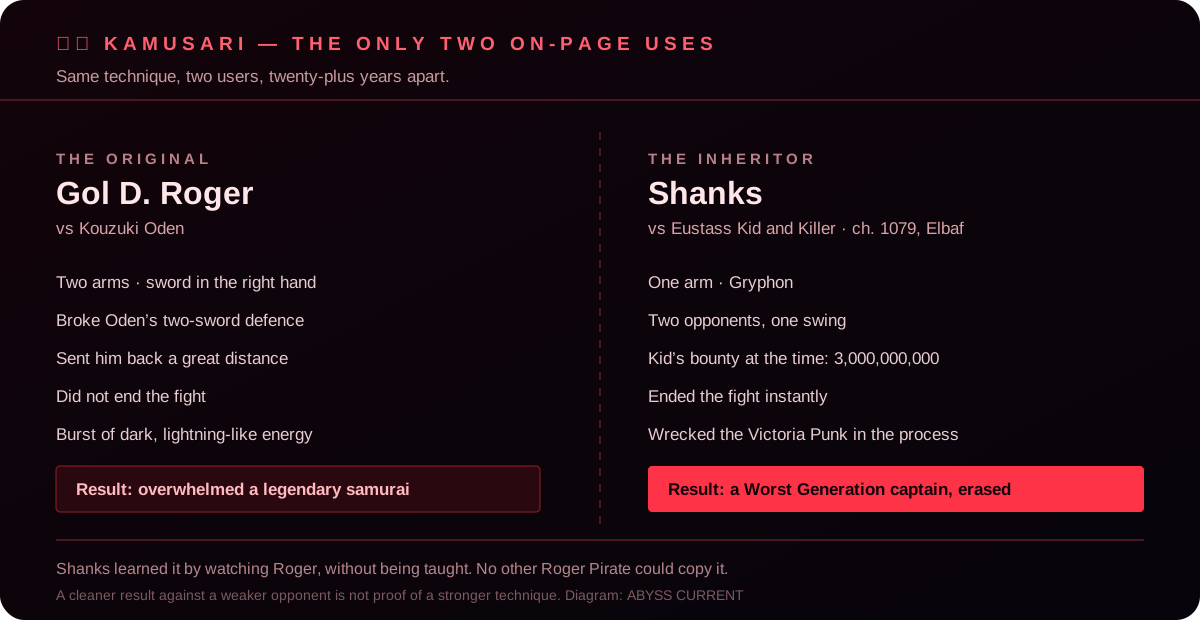
Shanks gets the cleaner result. Kid is also not Oden. Both things are true and the second one matters. Diagram: ABYSS CURRENT
Roger's Kamusari vs Shanks' Kamusari
There are exactly two on-page uses, and comparing them is where most power-scaling goes wrong.
Roger, against Kouzuki Oden. Two arms, sword in the right hand. The strike overwhelmed Oden's two-sword defence and sent him back a great distance in a burst of dark lightning. It did not end the fight.
Shanks, against Kid and Killer. One arm, Gryphon, at Elbaf in chapter 1079. He read Kid's Damned Punk with Future Vision before it fired, warned his fleet to scatter, crossed to the Victoria Punk, and ended both Kid — a three-billion-berry captain who had just helped bring down an Emperor — and Killer with a single swing. The ship was wrecked in the aftermath.
The tempting conclusion is that Shanks' version is stronger: cleaner result, one arm, two targets. We would not make that claim, and the reason is simple. Kid is not Oden. A technique that fails to finish a stronger opponent and succeeds against a weaker one has told you about the opponents, not about the technique. Doing it one-armed is a genuine point in Shanks' favour. It is not the same as evidence that his Kamusari hits harder than the Pirate King's.
We score that specific claim at 3/10 further down.
Observation Killing: official, but not yet on the page
見聞殺し — Observation Killing comes up constantly in answers to this question, usually described as Shanks' signature or his most dangerous ability. It is an advanced Conqueror's Haki application, and the wording available to us turns on Shanks controlling his own presence in a way that stops others seeing into the future. That wording supports two different abilities — hiding himself from someone looking ahead, or denying them the look entirely — and we do not resolve it here. An earlier version of this passage stated both readings in consecutive sentences without noticing; we take the ambiguity apart in can Shanks cancel Future Sight?.
Where it comes from is Volume 4000000000 "RED", the official guidebook released alongside ONE PIECE Film: Red. The same book is the source for the "fiery" aura Gryphon is sometimes described as producing.
To be clear about what that does and does not mean: this is official material, not fan invention, and guidebook entries of this kind have a good record of being borne out later. It is layer 2 on our chart, not layer 3. What it has not been is demonstrated in the serialised manga — the name has never appeared in a chapter, and no scene has shown the effect happening.
So it is a real ability with a real source that cannot yet settle a question about Shanks' strongest attack, for two separate reasons: it is not a chapter feat, and it is not an attack. It scores 4/10 here on that basis, which is a comment on what has been shown, not on the material's standing.
MANGA-CONFIRMED→OFFICIAL SUPPLEMENTARY→INFERENCE
The strongest thing Shanks has done is not an attack
If the question is "what is Shanks' strongest attack", the answer is Kamusari. If the question is "what is the most impressive thing Shanks has been shown doing", the answer is not an attack at all, and it is not close.
He released a burst of Conqueror's Haki that paralysed Admiral Ryokugyu from miles offshore, stopping him without entering Wano. Jinbe and Yamato both described it as monstrous.
Boarding the Moby Dick, his presence alone knocked out dozens of Whitebeard's veteran crew and damaged the ship itself.
Jinbe's assessment at Fish-Man Island was that where Luffy's Conqueror's Haki dropped 50,000 of the New Fish-Man Pirates, Shanks' would have dropped all 100,000.
Immediately after a Sea King bit his arm off, he drove it away with a glare.
None of these has a technique name. All of them are on the page. This is the shape of Shanks as a fighter: his ceiling is expressed through raw Haki output far more often than through named moves, and a "strongest attack" question captures only part of him by design.
Strongest attack
Kamusari
A named, targeted, offensive technique
One swing, two Worst Generation fighters
The only thing here the manga has labelled
Confirmed twice: Roger's use and Shanks'
Strongest showing
Haki alone
Paralysed an Admiral from miles offshore
Knocked out dozens aboard the Moby Dick
Damaged the Moby Dick by presence alone
Never given a technique name at all
What the Elbaf arc added — and what it capped
The Final Saga has expanded Shanks' history enormously without adding a single technique to his list. Two entries from it belong in any serious answer.
The first is a correction — to a common reading, and to an earlier version of this page. In chapter 1170, Gaban tells Shanks that the Knights of God are weak to anyone who can put Conqueror's Haki into an attack: the wounds hurt, recovery slows badly, and repeated hits can put them out of the fight. He explains how he knows: back in the Roger Pirates era, the Knights repeatedly came to take the young Shanks back, and Gaban cut them up and sent them back each time. Shanks' reply is that someone called Sommers had said as much. That is Gaban's feat, recalled in dialogue. It puts Sommers in Shanks' history; it does not put Shanks in a fight with him, and it adds nothing to Shanks' list of attacks. (CHAPTER-REFERENCED: several independent chapter summaries agree; not re-read on the page for this correction.) That exchange is also where the rule the entire Elbaf arc now runs on gets stated out loud, which we traced through the whole island in our ranking of the strongest Elbaf characters.
The second is a cap, and it should be reported as one. Fourteen years ago at Aurust Castle, Shanks and Gaban fought the covenant-corrupted Harald together and could not finish him. Their hits landed and healed slowly; Gaban concluded that Loki was their only hope. Whatever Shanks' best attack is, it did not close that fight. Six years ago he did defeat and capture Loki himself — the strongest giant on Elbaf, special bounty 2.6 billion, a fighter nobody else had stopped — but that happened entirely off-page, which makes it useless for ranking a technique.
Roger Pirates eraRoger uses Kamusari on OdenSword in his right hand, infused with Conqueror's Haki, swung horizontally. It breaks Kouzuki Oden's two-sword defence and sends him back a great distance in a burst of dark lightning. It does not end the fight.
Apprentice yearsShanks copies it by watchingHe picks the technique up from observing Roger in battle, with no instruction. The other Roger Pirates could not do the same. This is the detail most explainers skip, and it is the one that says the most about him.
Same eraThe Knights come for Shanks — Gaban sends them backGaban recalls in chapter 1170 that the Knights of God repeatedly came to take the young Shanks back, and that he — Gaban — cut them up and sent them back each time. Shanks replies that someone called Sommers had said as much. The feat is Gaban's, not Shanks'. It is where the arc's rule about Conqueror's Haki and covenants starts.
14 years agoAurust Castle — the honest capShanks and Scopper Gaban together fight the covenant-corrupted Harald and cannot finish him. Gaban notes their hits land and heal slowly; Loki has to end it. Whatever Shanks' best attack is, it did not close this fight.
6 years agoShanks captures LokiHe defeats and captures the strongest giant on Elbaf, a fighter with a special 2.6 billion bounty whom nobody else had been able to stop. Entirely off-page, which is why it cannot be used to rank a technique.
Chapter 1079Kamusari, named, at ElbafShanks reads Kid's Damned Punk before it fires, leaps ships, and ends both Kid — bounty 3,000,000,000 — and Killer with one swing of Gryphon. The chapter names the attack.
Chapter 1191Still nothing newThrough the latest published chapter, Shanks has not been shown using a second named technique. The Elbaf arc has deepened his history considerably and added nothing to his move list.
How strong is Kamusari, really?
Three benchmarks, in descending order of usefulness.
Eustass Kid and Killer, simultaneously, in one swing. Kid's bounty was three billion berries, and he was one of the two captains who had brought down Big Mom. He was not injured going in — Shanks asked after his Wano wounds and was told he looked fine. This is the strongest confirmed thing Kamusari has done.
Kouzuki Oden, in Roger's hands. Broke his guard, moved him, did not beat him. This is the technique's confirmed ceiling failing, which is more informative than its successes.
Everything else is inference. Shanks matched a blow from Whitebeard and their clash split the heavens; he blocked Akainu's magma fist with Gryphon and Armament Haki. Neither was Kamusari. Attributing them to it is the same error as crediting a boxer's whole record to one punch.
Our score for "Kamusari is Shanks' strongest attack" is 8/10 — high, and capped only by the definitional point that his best showings are Haki bursts rather than attacks.
Ratings
Theory
Confidence
Heat
Load
Contra.
Score
Kamusari is Shanks' strongest attack
HIGH
HOT
LOW
LOW
8/10
Shanks' Kamusari is stronger than Roger's
LOW
WARM
HIGH
MEDIUM
3/10
Observation Killing settles the strongest-attack question
LOW
WARM
MEDIUM
LOW
4/10
ABYSS CURRENT RADAR
Kamusari is Shanks' strongest attack
8/10
Evidence8/10It is his only named attack, and its single on-page use took out a 3 billion-berry captain and his right hand together. Nothing else he has thrown is both offensive and labelled.
Independent signals8/10Japanese and English coverage converge on this answer, and for once the manga backs the consensus.
Assumption loadLOWRequires only that a named technique that one-shot two Worst Generation fighters is his best offensive move.
ContradictionsLOWThe main caveat is definitional — his most impressive feats are Haki bursts that are not attacks.
ABYSS CURRENT RADAR
Shanks' Kamusari is stronger than Roger's
3/10
Evidence3/10Shanks gets the cleaner result, but against a far weaker opponent. Roger's version failed to finish Oden; Shanks' finished Kid. Those opponents are not comparable.
Independent signals5/10A common claim in both fandoms, usually resting on the one-arm detail rather than on the targets.
Assumption loadHIGHTreats outcome as a property of the technique rather than of the matchup.
ContradictionsMEDIUMRoger is consistently written as the ceiling Shanks is measured against, not the other way round.
ABYSS CURRENT RADAR
Observation Killing settles the strongest-attack question
4/10
Evidence4/10It is official material — an Oda-supervised guidebook entry, not a fan reading. But it comes from Volume 4000000000 "RED" rather than a chapter, and has never been named or demonstrated in the serialisation.
Independent signals6/10Widely repeated in both languages, usually without the source being mentioned.
Assumption loadMEDIUMAssumes official supplementary material settles a question the same way a demonstrated chapter feat does. We rank it below a chapter, not below a fan theory.
ContradictionsLOWNothing contradicts it; it simply has not been demonstrated on the page.
Frequently asked
What is Shanks' strongest attack? Divine Departure, 神避 Kamusari in Japanese — a Conqueror's Haki-infused sword strike inherited from Gol D. Roger. He used it in chapter 1079 to defeat Eustass Kid and Killer in a single blow. It is also the only attack of his the manga has ever named.
What does Kamusari mean? It is a word from the Kojiki referring to the death or departure of a kami — a god. VIZ renders it as "Divine Departure".
Is Divine Departure the same as Kamusari? Yes. Kamusari is the Japanese name; Divine Departure is the official English translation used by VIZ and Funimation.
Who else can use Divine Departure? Only Gol D. Roger, who used it first. Per Oda's Q&A in Volume 111, Shanks learned it by watching Roger fight, without instruction, and no other member of the Roger Pirates could copy it — an author statement rather than something shown in a chapter. Gaban's Kamudo (神門, "God Gate") is a separate, similarly named Conqueror-infused technique, not the same move.
Is Shanks' Kamusari stronger than Roger's? Unproven, and we score it 3/10. Shanks got the cleaner result, but against a much weaker opponent — Roger used it on Oden, Shanks on Kid. Doing it one-armed is a real point in his favour; it is not evidence the strike itself hits harder.
What is Observation Killing? An advanced Conqueror's Haki application credited to Shanks, described in terms of controlling his own presence so that others cannot see into the future. Whether that hides him or denies the ability outright is not settled by the wording we can reach — see can Shanks cancel Future Sight?. It is official material, from the Volume 4000000000 "RED" guidebook, it has never been named or demonstrated in the serialised manga, and it is not an attack.
Does Shanks have any other named attacks? No. Through chapter 1191, Divine Departure is his only attack named in the serialised manga. Everything else attributed to him is either an unnamed feat, a guidebook entry, or film material.
What could change this answer
A second named technique. Shanks has been circling the Elbaf conflict for the whole Final Saga without fighting seriously on-page since 1079. The moment he does, this article needs revisiting.
A Kamusari that fails. Its only two uses were a partial success and a total one. A version that bounces off a covenant-holder or an Emperor would tell us far more about its ceiling than another one-shot would.
Observation Killing appearing in the manga. It would move from the guidebook column to the confirmed one, and become a serious rival for "most dangerous ability" even though it is not an attack.
Shanks vs Shamrock. The twins have not fought. Shamrock now sits fifth in our Elbaf ranking on command position and equipment rather than completed feats, and the single fastest way to fix that record would be a fight with his brother. Whatever Shanks brings to it will be the best answer this question ever gets.
Our call
Kamusari is the right answer, and the reason it is such a clean one is slightly unusual: Shanks has been given exactly one named attack in nearly 1,200 chapters, and it happens to have flattened a three-billion-berry captain the only time we saw it.
But the more useful thing to know about Shanks is that his named move is not where his ceiling lives. The Ryokugyu paralysis and the Moby Dick — neither has a name, and both say more about him than Divine Departure does. He is a fighter the manga characterises through pressure rather than through technique, which is why the "strongest attack" question keeps producing thin answers.
A companion piece runs the same question on the man who fought Roger from the other side: what is Garp's strongest attack? — he has four named techniques to Shanks' one, which makes his answer far messier.
Next in this cluster: the God's Knights themselves, ranked, whose covenant immortality is the thing Conqueror's Haki was set up to counter — the rule Gaban was applying on the young Shanks' behalf, long before the Elbaf arc made it a plot point. Harald, the one Knight ever confirmed to use that Haki, tops it; Shanks was never knighted at all. Their commander's placement is also in the Elbaf ranking. In the meantime, where every fighter on Elbaf currently stands is the piece this one grew out of, and the chapter 1191 Imu question covers the opponent all of it is now pointed at.
Change log
1 September 2026 — First published, current through chapter 1191.
2 September 2026 — Linked the God's Knights ranking.
3 September 2026 — Linked the companion piece on Garp's strongest attack.
20 September 2026 — Corrected the currency note, which still described chapter 1192 as forthcoming after 1192 and 1193 had both published. Rankings and the attack analysis are unchanged; this piece still covers published chapters through 1191.
20 September 2026 (second revision) — Withdrew our characterisation of Observation Killing. This page described it as suppressing Shanks' presence so that opponents using Future Vision cannot read him — the narrow reading — and then, in the next sentence, as "an ability that switches that off", which is the broad one. Neither was hedged, and the lead-in called the description accurate. The wording we can reach supports both readings and settles neither, so both passages now say so and point to can Shanks cancel Future Sight?. The ability's evidence layer, its 4/10 score and the strongest-attack answer are unaffected.
1 September 2026 (revised) — Re-audited every claim against its primary source. The "learned by watching Roger" detail is an author statement from Oda's Q&A in Volume 111 (p. 217), not a chapter, and is now labelled as such. Restructured the evidence chart into three source layers — manga-confirmed, official supplementary, inference — so that supplementary material reads as official rather than as doubtful. Title updated to lead with the VIZ translation, Divine Departure.
5 October 2026 — Corrected a misattribution from chapter 1170. This page credited Shanks with driving off the Knights of God as a teenager. In the chapter, Gaban recalls that he cut them up and sent them back when they came for the young Shanks; Shanks only replies that Sommers had said as much. Several independent chapter summaries agree. Removed the item from Shanks' layer-1 list (table and diagram), and rewrote the Elbaf section, the timeline entry and the closing to match. Divine Departure remains the answer; nothing else in the analysis depended on that item.