Quick answer
Maybe one — and possibly not even that. Japanese readers flagged three spots in chapter 1196. Our read of each:
| Where | What's printed | What it probably is |
|---|---|---|
| Ivankov to Sanji | 「投げ槍」 with the reading なげやり | Unclear: typo or pun. The usual spelling is 投げやり, careless. 投げ槍 means a throwing spear, in a chapter about a spear. |
| Killingham's line | 「深層心理というやっだ」 | Looks like a lettering slip — やつだ, that's what it is, with a small っ where つ belongs. |
| Ivankov's proverb | 「雨垂れ石を穿つ」 | An unusual use, not a typo. The proverb normally praises persistence; Ivankov uses its literal picture. |
PRIMARY — MANGA VERIFIED. Text checked against the official release of chapter 1196 on Shonen Jump+, as we read it on 19 October. The reader reaction is quoted from Japanese YouTube, as reaction rather than fact.
1. 投げ槍 — careless, or a throwing spear?
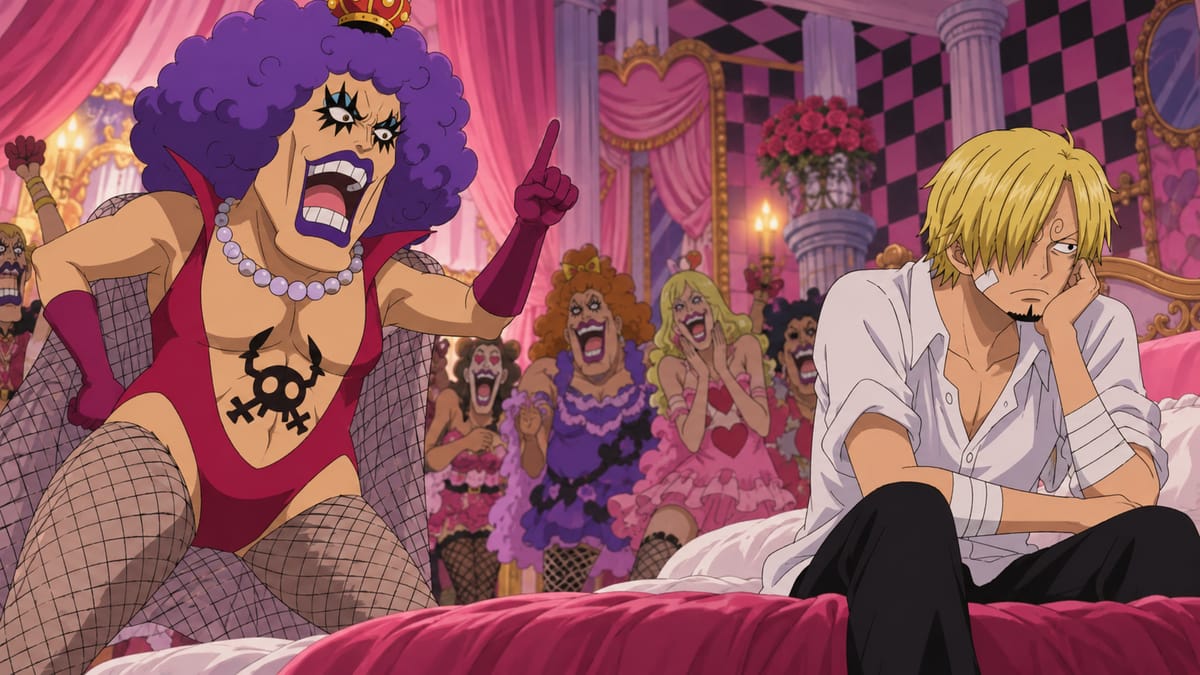
The line. In the Kamabakka flashback, Ivankov scolds Sanji for taking hits he could avoid: 「無鉄砲なの!? 投げ槍なの!?」 — are you reckless? are you careless?
What Japanese readers object to:
- The usual spelling. なげやり (careless, half-hearted) is written 投げやり, or 投げ遣り in full kanji.
- What's on the page. 投げ槍 — the kanji for 槍, a spear. Read literally, a thrown spear.
- The reaction. A widely shared YouTube comment points out the correct kanji.
Why it may be deliberate:
- The fight. The chapter's fight is against Killingham, whose weapon is the spear Longinus (聖命槍). Sanji is literally being run through with a spear while he remembers being called 投げ槍.
- Oda's habits. Oda routinely puts a word's sound over different kanji. The same chapter gives Killingham's move 夢出力 the reading アうとうとプット — "output" with utouto, nodding off — and his 退場 the reading ログアうとうと.
Our call: we can't tell from the page. The furigana なげやり shows the intended sound. Whether the spear is a joke or a slip is Oda's and the editors' to say.
2. やっだ — a small っ
The line. Killingham explains why Sanji's nightmare is Ivankov: 「それが深層心理というやつだ!!」 — that's what they call your deep psychology.
What's on the page.
- What we see. In the release we read, the kana looks like やっだ: a small っ, a geminate mark, where a full-size つ belongs.
- Why it doesn't fit. やっだ isn't a word in this sentence.
- What it most likely is: a lettering slip, the easiest kind to fix.
3. 雨垂れ石を穿つ — the proverb used backwards?

The line. Ivankov warns Sanji: 「雨垂れ石を穿つ」ってね!! — you know, "dripping water wears through stone" — and explains: however tough a body is, pile up small wounds and one day it breaks.
The usual meaning. Dictionaries give 雨垂れ石を穿つ as a positive proverb: small, steady effort achieves something great in the end. It traces back to the classical Chinese Book of Han.
What Ivankov does.
- The image. He uses the proverb's literal picture: drops wearing away stone.
- The meaning. He makes it a warning about damage rather than praise for persistence.
- The verdict. That's why some readers call it a misuse. Others would call it a fair reading of the image.
Our call: not a typo, and not wrong about the image. It's just not the sense the proverb is usually quoted for.
Why this became a story in Japan
On Japanese YouTube:
- The typo video. One video titled as if the chapter were "full of typos" passed 40,000 views within a week.
- The comments. They go beyond the three spots, to complaints about dialogue, wording and the editors.
- The anti side. Another channel built around criticising the series also cleared tens of thousands of views on 1196.
Context matters (our reading):
- Corrections are normal. Weekly serialisation runs on a hard deadline, and tankōbon volumes routinely fix magazine text. Volume 112, for example, changed Gunko's credit to 「マンマイヤー家 軍子宮」. If 1196's lines are slips, the volume edition is where they would be corrected.
- The loudest voices aren't neutral. Some of them come from channels that criticise the series as their format. That doesn't make every point wrong, but it explains the heat.
What to watch
- The volume edition. Does the collected volume change 投げ槍, やっだ, or the proverb line?
- Oda's own word. Whether Oda mentions any of it — in an SBS Q&A, for example.
Read next