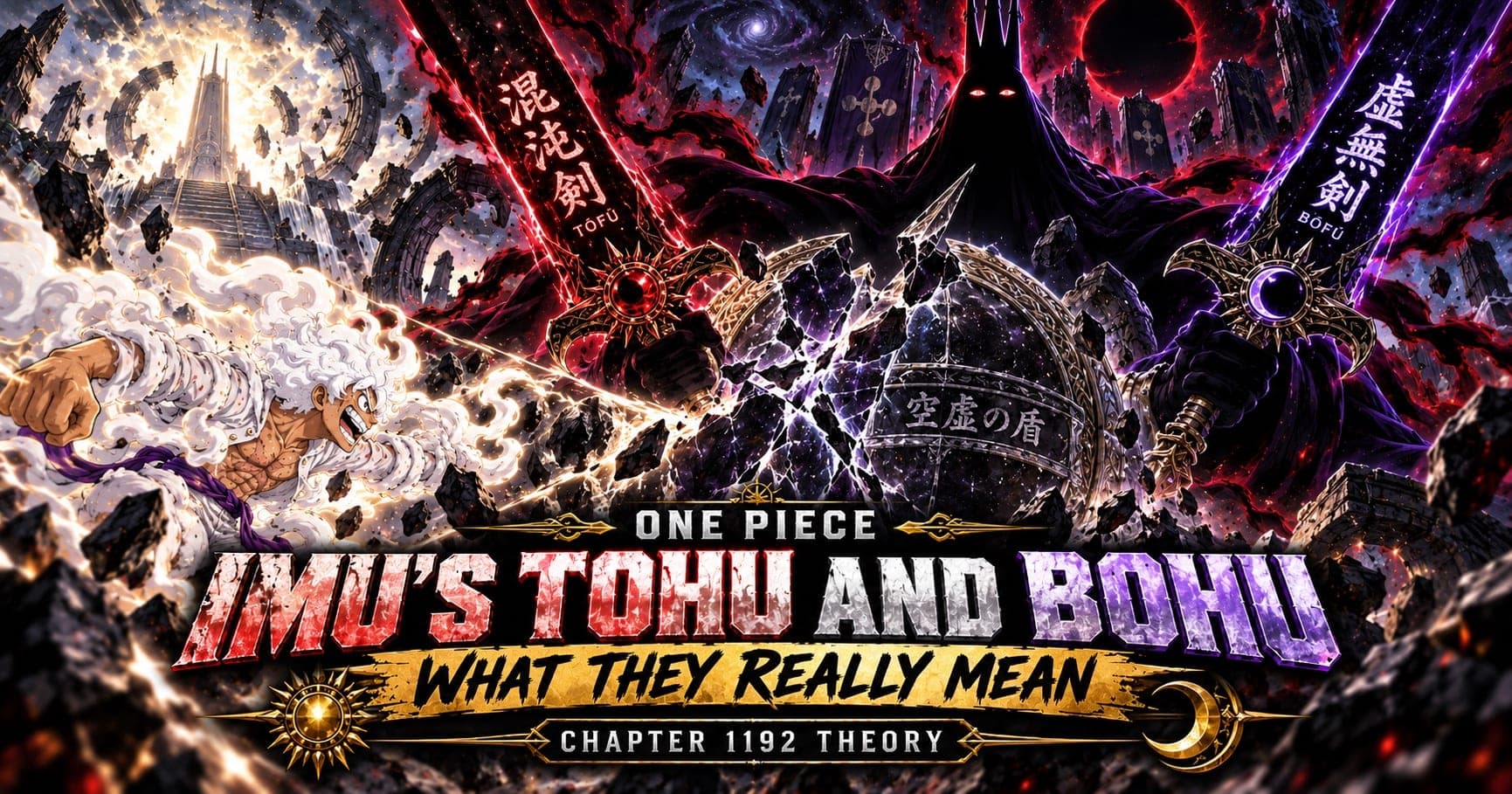
This page covers what the names mean. For what the shield is and how Luffy and Loki broke it in chapter 1192, see our chapter 1192 report.
Quick answer
Imu's weapon names in ONE PIECE chapter 1192 line up with the Hebrew phrase tohu wa-bohu from Genesis 1:2 — in sound, in order, and in meaning.
The two blades are written 混沌剣 and 虚無剣 and given the readings Tōfū and Bōfū. The shield they combine into is written 空虚の盾 and given the reading Tōfū-wa-Bōfū. In Genesis 1:2 the earth is tohu wa-bohu, rendered in English as "without form, and void."
The kanji are the reason this is worth writing about rather than filing under coincidence. 混沌 is chaos. 虚無 is void or nihility. 空虚 is emptiness. Those are the same semantic field the Hebrew phrase occupies — so the match is not only phonetic.
That makes a Genesis reference highly plausible. It does not tell us what Imu is. The larger idea — that Imu stands for the formless dark before creation and Nika for the light that follows — is a reading of the imagery, and we have labelled it as one.
Read directly from the official Japanese release — Weekly Shonen Jump 2026 issue 41, ONE PIECE chapter 1192「おれ達が許さねェ!!!」. Evidence label: PRIMARY — MANGA VERIFIED. No leaks, no raw scans, no scanlations.
What are Imu's new weapons called in chapter 1192?
We went back to the printed page and read the furigana at full resolution rather than trusting a first pass, because the order turned out to matter more than anything else here.
| On the page | Kanji meaning | Ruby (reading) | Romanised |
|---|---|---|---|
| 混沌剣 | "chaos" + sword | トーフー | Tōfū |
| 虚無剣 | "void, nihility" + sword | ボーフー | Bōfū |
| 空虚の盾 | "emptiness" + of + shield | トーフー・ワー・ボーフー | Tōfū-wa-Bōfū |
The shield's name is the detail that carries the argument. In vertical Japanese the ruby sits beside the characters it annotates, and here it is distributed across the whole phrase:
- 空虚 takes トーフー
- の takes ワー
- 盾 takes ボーフー
So the name is not "chaos sword plus void sword" stuck together. The Japanese possessive particle の is being used to carry the sound of the Hebrew conjunction. Read straight down the column, the shield is Tōfū · wa · Bōfū.
The reading order, exactly as printed
TŌFŪ-WA-BŌFŪ
- 空虚 carries the ruby トーフー
- の carries the ruby ワー
- 盾 carries the ruby ボーフー
- Read down the column: Tōfū · wa · Bōfū
Why the order is the whole argument
MATCHES
- Hebrew: tohu wa-bohu — same three parts, same order
- The Japanese possessive の is doing the work of the Hebrew conjunction
- A coincidence would not need the middle particle to line up
- Two sounds could be chance. Three in sequence is a different claim
For what the weapons actually did in the fight — Luffy's fists failing against the guard, and Loki launching him through it — we covered the mechanics separately in Luffy and Loki Break Imu's New Shield in ONE PIECE 1192.
What does "tohu wa-bohu" mean?
Genesis 1:2, in the Hebrew:
וְהָאָ֗רֶץ הָיְתָ֥ה תֹ֙הוּ֙ וָבֹ֔הוּ וְחֹ֖שֶׁךְ עַל־פְּנֵ֣י תְה֑וֹם
The JPS Tanakh renders the verse "the earth being unformed and void, with darkness over the surface of the deep." The King James renders the same phrase "without form, and void."
Taking the three parts separately, because the popular one-word gloss flattens them:
tohu (תֹּהוּ, Strong's H8414) — formlessness, confusion, unreality, emptiness, from a root meaning to lie waste. Its range across the Hebrew Bible includes waste, wilderness, vanity and empty place. It appears 20 times.
bohu (בֹּהוּ, Strong's H922) — emptiness, void; glossed as a vacuity or an undistinguishable ruin. It appears only three times in the entire Hebrew Bible: here, Isaiah 34:11, and Jeremiah 4:23. It is a rare word, and some scholars argue it exists chiefly to rhyme with and reinforce tohu.
wa (וָ) — the conjunction, "and."
Transliteration of the phrase varies between sources — tohu wa-bohu, tohu va-vohu, tōhū wāḇōhū. We use wa-bohu throughout this article because that is the form that lines up with the manga's own reading, Tōfū-wa-Bōfū; nothing turns on the choice beyond legibility.
Together they form a tightly paired expression, with bohu reinforcing the image carried by tohu. Which is why "chaos" is a serviceable gloss for the phrase but not a literal translation of tohu. Most careful English translations reach for "without form and void" or "unformed and void" rather than "chaos", and we are going to keep that distinction because the manga does something interesting with it.
Why the match is hard to ignore
Sound alone would be weak. Two invented weapon names happening to sound like two Hebrew words is the kind of thing that turns up constantly if you look for it.
What raises this above that is the kanji.
| ONE PIECE 1192 | Kanji sense | Hebrew parallel | Standard gloss |
|---|---|---|---|
| 混沌剣 (Tōfū) | chaos, primordial disorder | tohu | formlessness, waste, confusion |
| 虚無剣 (Bōfū) | void, nihility, nothingness | bohu | emptiness, void |
| 空虚の盾 (Tōfū-wa-Bōfū) | shield of emptiness | tohu wa-bohu | "without form, and void" |
Three things are lining up at once: the sounds, the kanji meanings, and the word order including the connective. Any one of them alone would be arguable. The third is the one that is hard to produce by accident — a coincidence does not usually need a middle particle.
One honest wrinkle, and we would rather raise it than let a reader find it: the pairing is not a tidy one-to-one. 混沌 ("chaos") sits on tohu, where the more literal sense of tohu is formlessness rather than chaos; 虚無 ("void") sits on bohu, which is the closer fit. So the manga is mapping onto the phrase's popular sense as much as its lexical one. That is what a reference usually looks like. It is not what a translation looks like, and we are not calling it one.
Read on the page in chapter 1192
- 混沌剣 is given the reading Tōfū
- 虚無剣 is given the reading Bōfū
- 空虚の盾 is given the reading Tōfū-wa-Bōfū
- The shield is formed from the two blades together
- Luffy's Gear 5 fists fail against it before it finally breaks
Not established by chapter 1192
- That Oda has confirmed any Genesis reference
- What Imu is, or what race, fruit or origin Imu has
- That the blades are made of Haki
- That Imu 'is' darkness, Satan, or a biblical figure
- That Luffy is standing in for a creator god