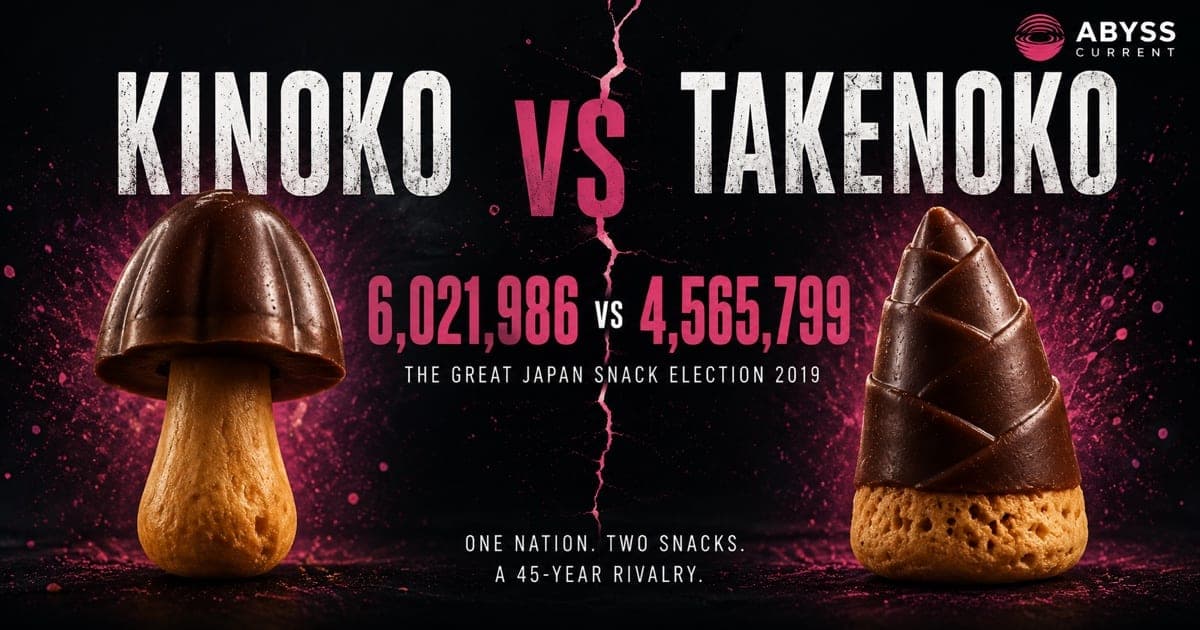
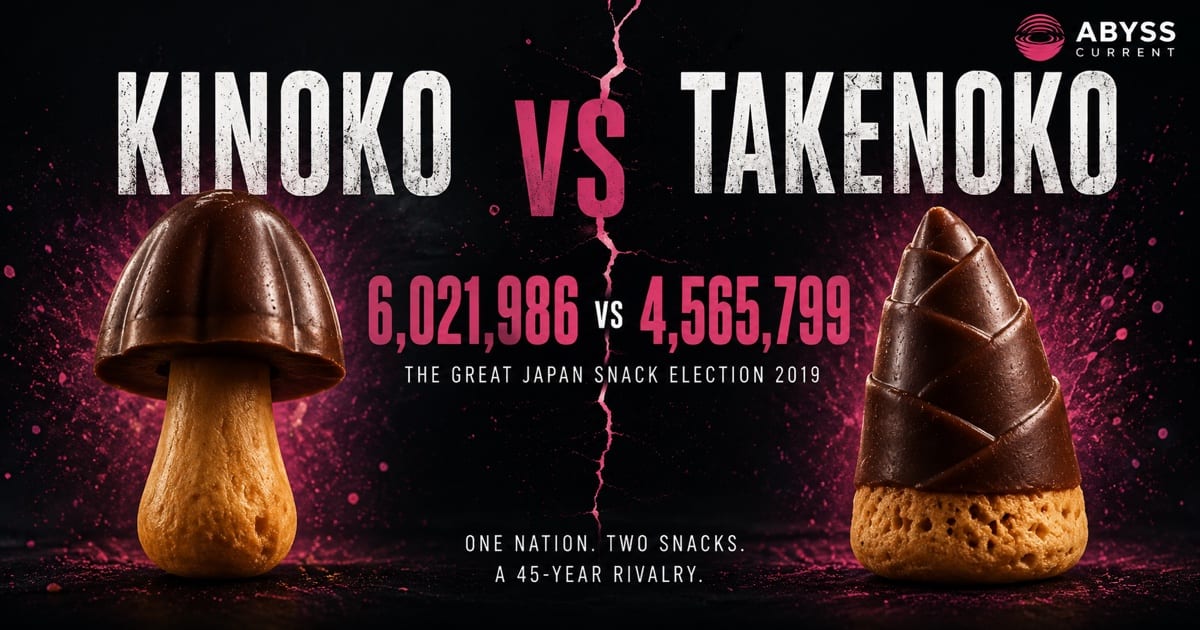
There is a question in Japan that will split a room faster than politics, and it is about chocolate. Kinoko, or Takenoko?
Ask it and people answer immediately. They do not say "I don't really mind." They pick a side, and then they explain why the other side is wrong. This has been going on for roughly fifty years, both products are made by the same company, and that company has now held three national elections about it.
Here is what the argument is actually about.
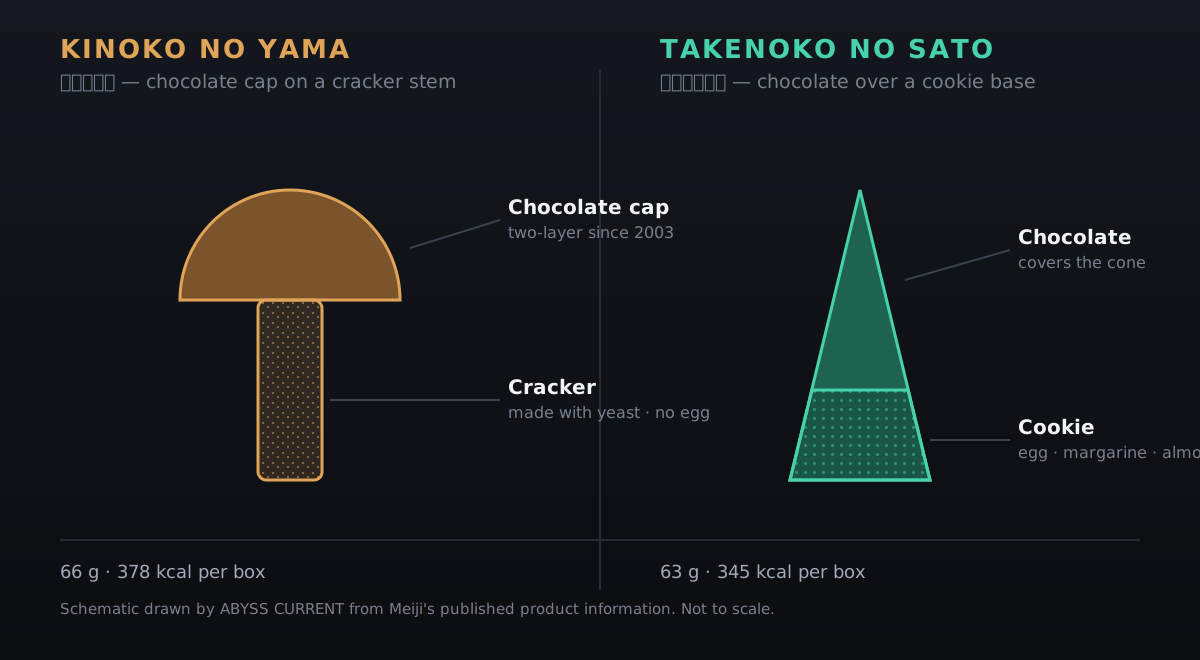
Kinoko no Yama きのこの山
1975
- Mushroom shape — a chocolate cap on a cracker stem
- 66 g box, 378 kcal
- Contains milk, wheat, soy
Takenoko no Sato たけのこの里
1979
- Bamboo-shoot shape — a cookie base under a chocolate coat
- 63 g box, 345 kcal
- Contains egg, milk, wheat, almond, soy, macadamia
What are Kinoko no Yama and Takenoko no Sato?
Both are made by Meiji, one of Japan's largest confectionery companies, and both are classified on the box as 準チョコレート菓子 — a semi-chocolate confection rather than a pure chocolate product.
Meiji's own brand history traces the idea back to 1970, when the company was thinking about the future of its small chocolate products. The mushroom shape took about five years to reach the market. Takenoko no Sato followed four years after that, and the argument started roughly the moment there were two of them.
The chocolate itself was rebuilt in 2003 into a two-layer construction — a milder chocolate and a more aromatic one — and both products were reformulated again in August 2019, their first renewal in eleven years.
The difference is bigger than it looks
The shapes are the joke. The actual difference is the baked part, and Meiji is precise about it in its own product language: Kinoko no Yama is built on a cracker, Takenoko no Sato on a cookie.
That distinction runs all the way down into the ingredient lists, which is where this stops being a matter of opinion.
Kinoko no Yama lists wheat flour, vegetable oil, cocoa mass, whole milk powder — and yeast. Yeast belongs to a cracker. There is no egg in it at all. Its declared allergens are milk, wheat and soy.
Takenoko no Sato lists wheat flour, liquid egg, egg white, margarine and almond paste. That is a cookie recipe, and it is a richer one. Its declared allergens are egg, milk and wheat, plus almond, soy and macadamia nut.
This is the most useful fact in this article, and it is a detail most snack comparisons miss: if you have a nut or egg allergy, these two products are not interchangeable. Kinoko no Yama contains neither egg nor tree nuts. Takenoko no Sato contains both. Buying "the Japanese mushroom chocolate thing" without checking which one you have is a real problem for some people, and the boxes look like a matching set.
The nutrition panels line up with the recipes rather than with anyone's opinion. Per box, Kinoko no Yama is 378 kcal across 66 g and Takenoko no Sato is 345 kcal across 63 g — close, but the Kinoko box runs slightly higher in fat and the Takenoko box slightly higher in carbohydrate. What that does on the tongue is a separate question, and we get to that at the bottom.
How Kinoko is built
- Chocolate cap, moulded separately
- Yeasted cracker stem — savoury, snappy
- The two parts meet; you can pull them apart
How Takenoko is built
- Cookie cone, baked as one piece
- Chocolate coating poured over it
- One object, not two — it does not separate
The allergen list is the one real difference for a visitor
The two are close on paper — a few grams, a few dozen calories. The ingredient panels are not close. Takenoko no Sato carries three allergens Kinoko no Yama does not.
Kinoko no Yama — listed allergens
- Milk
- Wheat
- Soy
Takenoko no Sato — listed allergens
- Egg
- Milk
- Wheat
- Almond
- Soy
- Macadamia
That is the practical reason to know which box you are holding, and it is the detail most comparisons skip. Meiji revises recipes — both products were reformulated in 2019 — so treat the above as what the current listings say and read the panel on the box you actually buy.
How Japan turned it into a rivalry
- 1975Kinoko no Yama launchesA chocolate cap on a yeasted cracker stem, shaped like a mushroom.
- 1979Takenoko no Sato launchesSame company, four years later: a cookie base under a chocolate coat, shaped like a bamboo shoot.
- Early 2000sMeiji runs the first national electionThe manufacturer turns the argument between its own two products into a campaign. Takenoko no Sato wins.
- 2018Takenoko wins againTwo campaigns, two wins for the same side.
- 30 July 2019The rematch is announcedAlongside the products' first renewal in eleven years. Voting runs 5 August to 2 December, with a celebrity party leader on each side.
- 17 December 2019Kinoko wins for the first time6,021,986 votes to 4,565,799 — just over 10.5 million cast, and Kinoko no Yama's first win in three attempts.
- 2020Meiji surveys all 47 prefecturesThe rivalry becomes a map of the country's preferences rather than a one-off campaign.
The part that surprises people outside Japan is that Meiji did not try to calm this down. It industrialised it.
The company has run three national elections — 国民総選挙 — between its own two products. Meiji's brand history places the first campaigns in the early 2000s, and Takenoko no Sato won. Takenoko won again in 2018.
Then came the rematch. Announced on 30 July 2019 alongside the products' first renewal in eleven years, the 2019 election ran from 5 August to 2 December, with each snack fielding a party and a celebrity leader: Matsumoto Jun for the New Kinoko Party, Miwa Akihiro for the New Takenoko Party. Voting ran through purchases, social posts and the web.
The result was announced on 17 December 2019:
Winner — New Kinoko Party
6,021,986
- Party leader: Matsumoto Jun
- First win in three attempts
Runner-up — New Takenoko Party
4,565,799
- Party leader: Miwa Akihiro
- Had won in 2018
Just over 10.5 million votes, and Kinoko no Yama's first win in three attempts. In 2020 Meiji followed it with a preference survey covering all 47 prefectures.
Two things are worth sitting with here. The first is the scale: ten and a half million votes is not a marketing gimmick that fizzled. The second is who benefits. Both parties are Meiji. Every vote is a vote for Meiji. The company took a genuine consumer split and turned it into a structure where partisanship is the product — and it has been running that structure, on and off, for two decades. Meiji has even given each side its own calendar date, 11 August and 10 March.
Why people actually care
It would be easy to write this up as Japanese people being charmingly intense about snacks. That is not what is happening, and the real explanation is more ordinary.
These products are everywhere, and have been for fifty years. They are in every convenience store, every supermarket, every station kiosk. A Japanese adult today has had access to both since childhood, at a price that never required permission from a parent. Preference formed early, with no stakes, and then never had a reason to change.
They also never stop moving. Between them the brand has run strawberry versions, matcha versions, regional milk versions, bitter chocolate versions, premium lines, build-it-yourself kits and collaboration flavours. Seasonal and limited editions give a long-standing preference something new to be loyal about several times a year.
And the choice is legible. Mushroom or bamboo shoot is a binary anyone can answer in under a second, with no expertise required, that reveals nothing embarrassing. That is close to the ideal shape for a small social ritual — which is why the question gets asked at all, and why the answer is delivered with more force than a biscuit deserves.
Which one should you try first?
We have not done a side-by-side tasting for this piece, so we are not going to tell you which is better. What we can do is point at the construction, because the construction is documented.
Start with Kinoko no Yama if you want the bigger textural contrast. A cracker stem under a chocolate cap gives you two distinctly different things in one bite, and the dry, yeasted base is doing something other than adding sweetness. It is also the safer box if you are avoiding egg or tree nuts.
Start with Takenoko no Sato if you would rather the baked half be good on its own. A cookie made with egg, margarine and almond paste is a richer object than a cracker, and the shape carries proportionally more chocolate. It has won two of the three national elections, which is at least a data point about mass preference.
Buy both if you actually want the experience the rest of this article is about. The point is not which snack is better. The point is that you now have a side.
Where this gets interesting from outside Japan
Exported, these stop being two snacks and become one artefact.
Almost every "Japanese snack" list treats them as two entries. They are not. They are a single fifty-year argument that a major company has repeatedly, deliberately, put to a public vote — and you cannot participate in it by buying one box. The interesting object is the pair, opened at the same time, with someone else in the room.
That is also the honest reason to care about them from abroad. Not because Japanese chocolate is exotic, but because this is a small, well-documented example of something Japanese consumer culture does unusually well: taking a trivial difference and building forty years of shared vocabulary on top of it.
Field notes
FIELD NOTES — PENDING. Everything above comes from Meiji's own product and press material. We have not tasted these for this article, and we are not going to pretend otherwise. Taste, texture, chocolate-to-biscuit balance, which one reads as sweeter, which is easier to eat by the handful, and where we personally land are all deliberately missing.
Field test pending — we will update this section after a side-by-side tasting in Japan, with our own photography.
If we open a shop, a both-boxes set is close to the top of the list. For now, there is nothing to buy from ABYSS CURRENT.